Strategic foresight games for adults preparing for advanced leadership programs
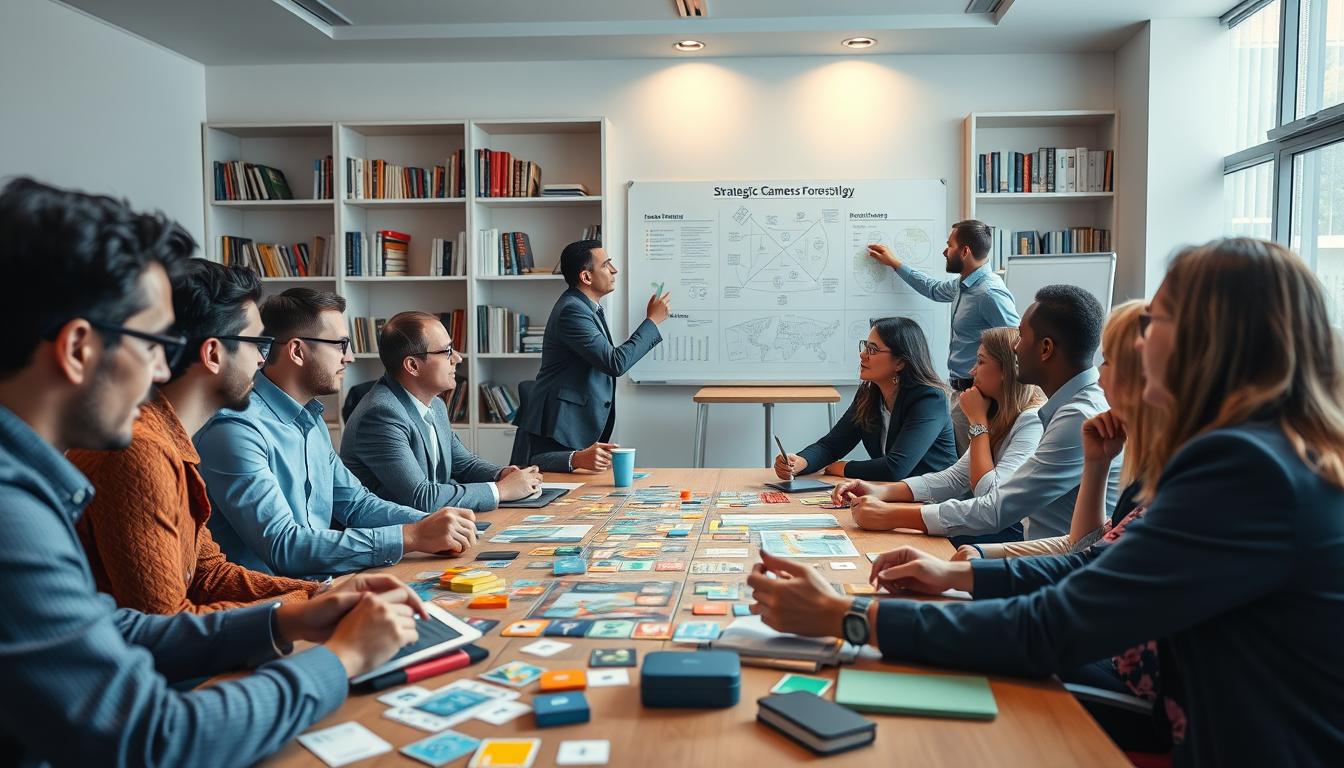
Can a short, well-crafted activity change the way a leader thinks under pressure?
This guide helps leaders, teams, and HR design and run foresight games that boost leadership skills and team dynamics. You will find clear ideas on activities, scenarios, and exercises that sharpen communication, thinking, and problem solving.
Experiential learning beats lectures: participants practice decision-making in safe scenarios and get immediate feedback that transfers to work. The guide maps activities by capability—strategic thinking, communication, and problem solving—and shows how to run strong debriefs.
Whether you are a facilitator, a leader, or a team member, expect practical steps to strengthen team dynamics, include every person, and measure outcomes. These methods aim to turn ideas into clearer thinking, stronger skills, and more resilient teams ready for real challenges.
Why strategic foresight games accelerate leadership development for adults
Short, immersive activities compress learning time by forcing real decisions and quick feedback among team members.
Research shows active training outperforms lectures. The Centre for Creative Leadership reports about 75% greater retention with experiential methods. Harvard Business School found a 23% larger performance gain for managers who trained by doing.
Hands-on activities let participants practice in realistic, time-bound scenarios. That practice helps them test assumptions, sharpen strategic thinking, and improve communication under pressure.
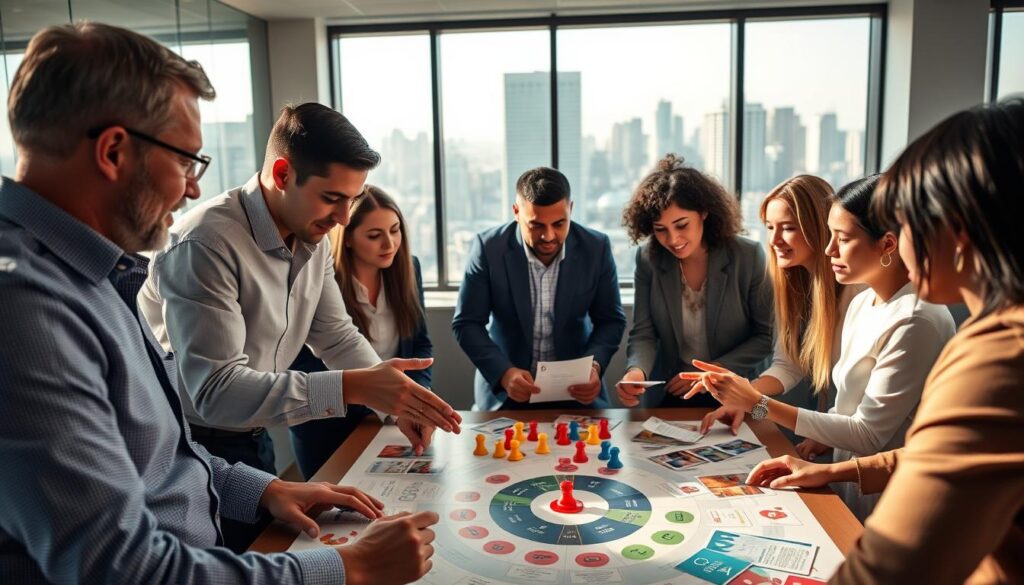
- Immediate relevance: participants see how new skills map to workplace situations.
- Fast feedback loops: teams try, get critique, and adjust communication and collaboration in real time.
- Safe failure: role-based exercises let leaders experiment without risking real business outcomes.
Exercises that engage emotion and multiple senses deepen memory and boost critical thinking. Peer learning and focused facilitation turn single events into lasting insights and clearer team norms. The net result: compressed learning time and stronger readiness for leaders and teams to act with confidence.
What defines a high-impact strategic foresight game
Effective practice recreates messy business trade-offs, delivering quick feedback that refines decision habits.

Experiential learning and immediate feedback loops
Design activities that follow Kolb’s cycle: concrete experience, guided reflection, conceptual insight, and a chance to try again. That loop fixes new thinking faster than lectures.
Built-in feedback comes from peers, facilitator notes, and direct consequences inside the simulation. Participants get clear signals about communication and decision quality right away.
Realistic pressure, safety, and measurable outcomes
Scenarios should mirror business constraints—competing priorities, scarce resources, and tight timeframes—without risking real operations. That creates useful tension.
Psychological safety is essential: encourage risk taking, honest debriefs, and error-based learning so participants can prototype new approaches.
- Align activities with outcomes and specify the skills to practice.
- Use leading indicators (communication clarity) and trailing indicators (behavior change).
- Scale rules by seniority and team size and document lessons for future planning.
Strategic foresight games for adults in leadership development
Well-designed simulations let leaders test plans and refine quick judgment under real pressure.
Scenario Planning Theatre
Guide participants through multi-horizon scenarios so teams practice strategic thinking, communication, and trade-offs.
Debates help members surface assumptions and compare viable options.
Market Conquest Simulation
Pit teams against shifting market moves and alliance offers.
This game pushes leaders to sequence decisions, manage time, and sharpen competitive analysis.
Crisis Management Theatre
Stage urgent incidents that force rapid decisions and stakeholder updates.
Participants practice clear communication and immediate action under pressure.
The Resource Allocation Dilemma
Ask participants to divide scarce budgets across priorities.
Teams must balance metrics, member input, and leadership aims while managing trade-offs.
- Set role cards (leader, customer, regulator) and give short, structured briefings.
- Pause between rounds for reflection and apply light metrics: decision speed, clarity, alignment.
- Make modules optional—add market shocks or stakeholder shifts to scale complexity.
| Exercise | Core skill | Metric | Adaptability |
|---|---|---|---|
| Scenario Planning Theatre | Strategic thinking, communication | Plan quality, debate clarity | High (multi-horizon) |
| Market Conquest Simulation | Competitive analysis, timing | Market share moves, decision lag | Medium (alliances, shocks) |
| Crisis Management Theatre | Decision speed, stakeholder comms | Response time, message clarity | High (incident variations) |
| Resource Allocation Dilemma | Financial trade-offs, influence | Budget alignment, stakeholder buy-in | Medium (budget size changes) |
Use cross-functional teams to broaden thinking and apply skills across real contexts.
Facilitator prompts should reveal hidden assumptions and link choices to organizational goals.
These exercises prepare teams to respond decisively to uncertainty while strengthening core leadership behaviors.
How these games map to adult learning science and retention
When practice mirrors work, participants learn faster and retain more.
Experiential programs show clear gains: about 75% greater retention than lectures and a 23% higher performance lift among managers who train by doing. That data explains why hands-on activities matter for leadership learning.
Relevant tasks let participants apply new skills immediately. Repetition and spaced practice across short modules embed habits and improve decision thinking over time.
Emotionally engaging scenarios boost memory consolidation. Reflection and structured debriefs turn moments into portable insights that transfer to business work.
“Practice under pressure builds confidence, and confidence leads to higher-quality decisions back at the workplace.”
| Mechanic | Effect | Why it matters |
|---|---|---|
| Active repetition | Stronger skill retention | Creates automatic responses during real tasks |
| Emotional engagement | Better memory consolidation | Improves retrieval under stress |
| Peer observation | Faster learning curve | Leaders adopt diverse approaches and get feedback |
Set measurable goals and plan follow-ups. Tracking skill gains makes learning visible and creates opportunities to apply insights on the job.
Best settings to run leadership games in the workplace or virtual environments
The space and platform you use shape how teams communicate, take risks, and learn together.
In-person settings suit physical interaction and trust building. Use conference rooms or training centers for decision simulations and boardrooms for focused briefings.
Retreats and offsites work well for multi-day activities that require deep reflection and culture work. Outdoor venues help with movement-based exercises and team bonding.
Virtual-first options and tools
Virtual platforms enable remote teams to run simulations and creative exercises. Use video calls for plenary briefings and Miro for shared canvases.
Gather.Town supports spatial collaboration for complex scenarios. Rehearse tools ahead of time and assign a tech support role to keep the session smooth.
Design, timing, and safety
Arrange spaces for accessibility and clear sightlines so participants can move and contribute without friction. Equip rooms with whiteboards, timers, and visible objectives.
Schedule sessions at peak energy, build in breaks, and set communication protocols. Rotate speaking order, set norms, and invite members to voice assumptions to create psychological safety.
- Recommend in-person for high-trust, physical activities; use retreats for deep culture work.
- Use video conferencing for briefings, Miro for collaboration, and Gather.Town for spatial play.
- Rehearse tech, define protocols, and assign on-call support.
- Match setting to goals: offsites for deep work, virtual sprints for rapid iteration.
- Checklist: comfort, accessibility, clear communication, visible objectives, and time for reflection.
How to choose the right games for your team and program goals
Start by mapping current capability gaps to specific practice exercises that match role demands.
Use assessments—360 feedback, performance reviews, and stakeholder interviews—to pinpoint the exact skills to target. That data guides which activities will move the needle for participants and teams.
Match complexity to seniority: emerging leaders benefit from structured scenarios with clear rules. Senior leaders need open-ended exercises that surface ambiguity and test judgment.
Practical selection checklist
- Start with diagnostics and link choices to measurable outcomes and stakeholder expectations.
- Align designs with team culture and industry priorities so exercises feel relevant and accepted.
- Plan within time, budget, space, and facilitator capacity to ensure smooth delivery.
- Balance your portfolio across communication, strategic thinking, and execution skills.
- Define participant roles, prepare briefs or pre-reads, pilot with a small team, then scale.
When you tie selection to real data and logistics, programs are easier to run and more likely to change behavior.
Strategy and planning: games that sharpen long-range thinking
Long-range planning benefits when teams practice choosing trade-offs under real time pressure.
The Innovation Challenge asks small teams to solve a complex business problem with limited resources and strict time limits. This game trains creative problem solving, resource allocation, and quick prioritization.
Scenario Planning Theatre walks participants through alternative futures. Teams map multiple states, stress-test assumptions, and build response options that align near-term plans with multi-horizon aims.
Market Conquest Simulation simulates shifting market conditions. Participants practice competitor analysis, alliance choices, and adaptive execution while tracking consequences across rounds.
- Use clear criteria (risk, ROI, feasibility) so teams compare options consistently.
- Require evidence-based justification and explicit trade-off statements.
- Build iteration into rounds so participants test, absorb consequences, and revise plans.
- Capture decisions on visible canvases to record logic for debriefs and future learning.
- End with a focused debrief linking choices to organizational plans and success metrics.
Cross-functional groups reveal blind spots and surface diverse ideas. Emphasize long-range implications to help participants connect short-term wins to sustained business success.
Communication and coordination: games that surface team dynamics
Simple, timed activities surface who speaks up, who listens, and where messages break down.
The Telephone Network routes a complex brief through several people to reveal bottlenecks and missing protocols. Teams see where phrasing fails and which handoffs need clearer rules.
The Telephone Network
Route a multi-part message across participants and score accuracy. Use the results to teach concise language and confirmation techniques.
Blindfold Communication
Pair a guide and a blindfolded team member. The guide must give precise instructions while the partner executes. This builds trust and sharp active listening.
Collaborative Construction Challenge
Split into sub-teams that must build a structure under time and resource limits. The task trains delegation, handoffs, and project management skills.
- Emphasize concise language, confirmation checks, and a shared vocabulary to lower misinterpretation.
- Explore nonverbal cues and escalation paths so work keeps moving under time pressure.
- Rotate roles so each person practices sending and receiving messages.
- Debrief dynamics: who led, how teams recovered, and which skills to practice next.
- Translate ideas into action items—update charters or checklists to embed improvements in the workplace.
Problem-solving under pressure: games for critical and creative thinking
Fast, focused problem drills force teams to make trade-offs while the clock ticks.
These short activities train critical thinking and quick decision making. Each exercise asks a small group to organize work, test ideas, and agree on solutions under tight time limits.
Puzzle Challenge
Split complex tasks into chunks and assign them. Teams must sequence steps, sync handoffs, and recover when errors occur. This builds coordination, planning, and time management.
The Information Integration Game
Give each participant unique clues that only form a clear picture when combined. The activity forces questioning, summarization, and shared sense-making across the team.
The Egg Drop
Provide limited materials to protect an egg from a drop. Rapid prototyping and testing spark creative engineering and risk-aware thinking.
- Rotate decision leaders to grow judgment and shared ownership.
- Use visible timers to mimic urgent situations and calm execution.
- Debrief how teams balanced speed with accuracy and surfaced missing information.
- Document solution patterns and translate them into simple rules of thumb.
| Exercise | Core focus | Outcome | Time |
|---|---|---|---|
| Puzzle Challenge | Coordination, sequencing | Improved planning and recovery | 15–25 min |
| Information Integration | Collaborative analysis | Clear synthesis and questioning | 20–30 min |
| Egg Drop | Creative prototyping | Rapid testing and trade-offs | 25–40 min |
Trust, cohesion, and psychological safety builders
Trust is the invisible infrastructure that lets teams take risks and learn faster. Psychological safety underpins high performance. Short trust builders accelerate connection and help participants move from guarded to open behavior.
The Human Knot
Players form a circle, cross arms, and grab hands at random. To untangle, members must give clear directions, listen closely, and move patiently without letting go.
This exercise sharpens communication and problem-solving under playful pressure.
The Trust Fall Evolution
Start with simple catches, then shift to professional scenarios: promises, handoffs, and small commitments. Progressively link physical trust to real workplace behaviors.
Use this to surface how members follow through and how the environment supports reliability.
The Trust Walk
Pair a sighted guide with a blindfolded person and navigate short routes. The activity trains precise instructions, empathy, and followership.
Set norms: get consent, offer opt-outs, and run a debrief. Ask reflection prompts such as “What felt risky?” and “Who helped you feel safe?”
- Spot micro-behaviors: thanking efforts, acknowledging risk, and celebrating attempts.
- Reinforce skills: clear commitments, asking for help, and closing loops on promises.
Leaders should model vulnerability and invite feedback. Capture simple agreements on how the team will keep trust alive during day-to-day work.
Decision-making and negotiation in complex scenarios
Negotiation and quick decision-making often reveal hidden priorities and test team processes under pressure.
Use tailored activities to train clear communication and durable outcomes. These exercises put participants into layered bargaining and urgent prioritization situations so leaders practice real choices.
The Negotiation Matrix
The Negotiation Matrix runs several simultaneous deals with hidden information. Participants must manage trade-offs, relationships, and sequencing to maximize collective value.
Prep includes defining BATNA, interests, and acceptable ranges. Assign a scribe, timekeeper, and lead negotiator to keep focus.
The Survival Scenario
Teams rapidly prioritize salvaged items and justify each choice. This forces concise reasoning and improves communication in ambiguous situations.
Desert Island prioritization
Desert Island tasks foster consensus-building and perspective-taking. Leaders debate criteria, align on rationale, and practice reaching shared solutions under time limits.
- Use scorecards that track outcomes and behaviors like listening and empathy.
- Debrief where misalignments happened and map fixes that preserve relationships and value.
- Link lessons to real business negotiations and cross-functional decisions.
“Clear roles and concise messages make agreements stick and speed post-decision alignment.”
These exercises hone thinking, build practical skills, and help teams translate classroom choices into workplace solutions.
Innovation and culture design: games that unlock creativity at scale
When people build simple prototypes and test rituals, creativity becomes repeatable across the organization.
The Invention Convention
Challenge teams to prototype bold solutions to real customer or internal problems using unconventional materials.
Encourage divergent and convergent thinking, then vet options against clear criteria: impact, feasibility, and cultural fit.
Culture Design Workshop
Map desired values, behaviors, and systems. Test small rituals and governance changes that align culture with goals.
- Rapid prototyping: build, test, and refine in short cycles to speed learning and cut risk.
- Use customer or stakeholder lenses so solutions meet real needs and constraints.
- Facilitate inclusive collaboration and raise quieter voices to broaden the idea pool.
- Capture selection criteria and translate top ideas into action plans with owners and milestones.
- Assign leaders to sponsor pilots and use meeting norms, artifacts, and recognition to reinforce new habits.
Close with concrete commitments. Turn inspiration into tracked experiments that embed continuous improvement across teams and the wider organization.
Common pitfalls to avoid when running leadership games
Common missteps can turn a sharp training exercise into a missed learning opportunity.
Start every session with clear objectives and success criteria so participants know what behavior to practice and why it matters to the workplace.
Avoid mismatching complexity with team capacity. Scale rules, assign realistic roles, and allocate enough time and resources to keep focus on learning rather than logistics.
- Don’t skip debriefs — structured reflection links the activity back to routine work.
- Keep mechanics simple; an elegant approach reduces cognitive load and improves engagement.
- Rotate formats to prevent fatigue and widen your team building portfolio across teams and contexts.
- Align each design with culture and values so exercises feel relevant and respectful.
- Manage psychological safety: offer opt-outs and alternatives so participants stay engaged without coercion.
- Prepare facilitators with a run-of-show, prompts, and contingency plans to ensure smooth support.
- Balance competition and collaboration so the challenge advances learning, not just winning.
- Document lessons learned and fold actions into team rituals to make gains stick.
“Clear goals, simple mechanics, and good debriefs turn short sessions into lasting change.”
Measuring impact: from debriefs to behavior change
Measure outcomes that matter: track how training changes choices at work, not just smiles on feedback forms.
Define impact metrics before you run activities. Use clear measures such as decision quality, communication clarity, speed under pressure, and observable post-session behavior changes.
Run multi-level debriefs to gather insights from participants and observers. Link those observations back to current business priorities so learning connects to real work.
- Collect immediate signals: self-ratings, peer feedback, and facilitator notes.
- Gather follow-up data: manager observations, project outcomes, and simple rubrics that track skills over time.
- Translate ideas into personal action plans and team operating changes; revisit commitments in later meetings.
- Apply a “measure, practice, measure” approach and tie results to performance dashboards to show ROI.
- Use creativity—nudges, checklists, and peer coaching—to reinforce learning and plan cadence for refreshers.
Celebrate quick wins and capture short case studies that show how small shifts in behavior led to real business results. Keep measurement light, repeatable, and focused on sustained behavior change.
Implementation blueprint for advanced leadership programs
A compact blueprint helps program leads move from concept to measurable practice fast.
Prep: objectives, role design, and materials
Start by aligning stakeholders on clear objectives and success metrics. Run a short participant assessment to map gaps and set targets for leadership skills.
Define roles: facilitator, observers, decision leads, and tech support. Gather materials and confirm time blocks with buffers for transitions.
Run: facilitation, tension, and real-time feedback
Keep instructions crisp and build productive tension so teams practice under realistic pressure. Use visible metrics and prompts to give immediate feedback.
Rotate roles across rounds to broaden exposure. Capture decisions on shared canvases so outcomes feed the debrief and organizational memory.
After-action: debriefs, reflection, and application plans
Conduct layered debriefs—individual, team, and cross-team—to link observed behaviors to results. Turn insights into action plans with owners, timelines, and measures.
Schedule follow-ups and short refreshers across weeks to sustain practice. Secure executive sponsorship to remove barriers and keep momentum.
“Clear roles, visible metrics, and systematic follow-up make practice stick.”
| Phase | Key tasks | Outcome |
|---|---|---|
| Prep | Align objectives; set metrics; assign roles; confirm logistics | Ready participants and defined success criteria |
| Run | Facilitate; build tension; provide real-time feedback; rotate roles | Observed behaviors and captured decisions |
| After-action | Layered debriefs; action plans; scheduled refreshers | Behavior change and tracked application |
Conclusion
Short, practice-rich sessions turn lessons into habits that show up at work. Well-run games help participants try choices, fail safely, and get quick feedback that boosts retention.
When activities mirror real tasks, strategic thinking, communication, and problem-solving skills improve fastest. Use clear debriefs so teams surface insights and link practice to everyday decisions.
Choose designs that match culture, time, and goals. Measure outcomes and repeat what works: consistent practice, not one-off events, creates lasting change across the team and broader teams.
Take action: pick one high-impact game aligned to your objectives, prepare the run, and commit to follow-through to drive success and new opportunities in your workplace.