Rapid-association brain games for adults stuck in repetitive daily patterns

Could a two-minute word sprint reset your focus and change how you handle the next task?
Short, targeted play offers a practical exercise to break the loop of dull habits and sharpen executive skills. These quick drills help people plan, focus attention, remember steps, and curb impulses without upending a schedule.
Apps such as Lumosity, Elevate, Peak, BrainHQ, CogniFit, NeuroNation, and Wordle-style tasks supply fast drills to boost processing speed, working memory, and flexibility. Team options like “Three Truths and a Lie” or brief stereotype-challenging prompts add social spark and rapid thinking practice.
This list highlights low-setup choices that fit a morning primer, a lunch break, or a late-afternoon reset. Expect five-to-fifteen-minute formats that sharpen focus, speed task switching, and smooth communication without derailing the workday.
Why rapid-association games snap you out of monotone routines
Quick associative drills act like a cognitive tap on the shoulder, shifting you from habit to intention.
These short activities target core executive functions that support planning, prioritization, and focused work. Flexibility, working memory, and inhibitory control get immediate practice when you must switch categories, keep recent answers in mind, and resist impulse responses.
Executive functions these activities target
Flexibility is engaged as you reinterpret cues and jump between concepts in seconds. Working memory is taxed when you hold prior replies, rules, and next options while producing a new link.
Inhibitory control shows up when you pause to avoid repeats or choose a better response under a timer. Over repeated sessions, this trains the ability to wait and select strategically.
Benefits in minutes: sharper focus, faster switching, lighter mood
- Sharper attention and faster task switching after a brief warm-up.
- Small wins boost mood and lower friction during long stretches of work.
- One short session can act as a micro intervention toward the larger goal of regaining attentional control.
For example, alternating category naming forces continuous reconfiguration of your mental set. That simple game produces measurable skill development over time and helps translate quick adaptation into smoother planning when schedules change.

How this list works: quick rules, low setup, five-to-fifteen-minute sessions
This roundup explains how short, repeatable drills fit into a busy day without fuss.
Every entry uses a single-sentence rule that you can teach in under a minute and a setup that needs minimal or no materials. Expect a clear goal, a short timer, and one simple constraint to keep the learning tight.
Sessions are designed to last five to fifteen minutes. That time frame leaves headroom for real practice while respecting work blocks and calendar limits.
Pick an activity based on context: solo work needs quick warm-ups, pairs favor back-and-forth turns, and groups should use inclusive prompts. Each game notes the core skills it trains so you can match choice to need.
- Scale difficulty with added rules or shorter time.
- Rotate formats to balance variety and familiarity.
- Track easy metrics like rounds completed or correct chains to mark progress.

Rapid-association brain games for adults with monotone routines
A brisk word-based warm-up gives your mind a fast reset before the next task.
Core mechanics to look for: speed linking, category switching, word chaining
Speed linking asks players to connect concepts quickly. Think moving from “apple” to “pie” under thirty seconds. This creates pressure that improves retrieval and pattern spotting.
Category switching means rotating categories on a timer. Set a buzzer at 30 or 60 seconds and flip from animals to tools. That trains flexible set shifting and keeps working memory engaged.
Word chaining uses simple links, such as last-letter to first-letter chains. It prevents repeats and forces continuous tracking of past answers.
Time-boxed challenges for busy workdays
- Use 30–60 second rounds to create urgency without derailment.
- Keep rules simple: “no repeats” and “switch on the buzzer” to boost inhibitory control.
- Add constraints—letters, themes, banned words—to sustain novelty.
- Record quick scores (links per round) so progress shows within a day.
- Rotate formats across the week to target varied executive skills and maintain engagement.
Desk-friendly solo brain sprints for a mid-day reset
Short solo sprints at your desk refresh attention and prime flexible thinking without fuss. These quick drills fit between meetings and never need more than a phone timer and a note app. Use them to break mental inertia and return to work clearer.
Word Ladder Blitz: change one letter, chain fast
Start with a base word and set a target. Change one letter per step to reach the goal as quickly as possible.
This game trains pattern recognition and working memory. Try two-to-five-minute rounds and log your best chain length.
Category Switch-Up: rotate categories every thirty seconds
List items from one category, then flip on a 30-second cue to a new category. Keep responses rapid and avoid repeats.
This activity builds set shifting under mild pressure. Count correct switches to track progress across the week.
Odd-One-Out Streams: spot and swap the outlier under time pressure
Generate short sets, pick the outlier fast, and replace it with a better fit. That forces inhibitory control and quick evaluation.
Use letter constraints or themed domains to vary difficulty. A simple timer app and sticky notes or a notes app make tracking easy.
Even a brief solo exercise can restore energy and clarity before an afternoon meeting. Small, regular sprints compound into real skill gains.
Two-player rapid challenges to energize short breaks
Pair-based drills create high-energy pauses that fit into any short break.
These partner activities boost focus and social connection in under two minutes. They work well between meetings and during quick lunch pauses.
Back-and-Forth Synonyms
Two players volley synonyms of a target word. No repeats allowed. A long pause or repeat resets the chain.
- Scoring: +1 point per valid reply; reset on repeat or pause.
- Tempo: two-minute rounds to keep energy high.
- Prompts: work terms, product names, or neutral themes to stay inclusive.
Micro Pictionary Prompts
One player sketches for ten seconds while the partner gets five seconds to guess. Quick turns train abstraction and speed.
- Level up by narrowing topics, cutting sketch time, or banning common clues.
- Rotate partners so team members meet others often and build rapport.
- End with one quick question: “What tripped you up?” to make learning explicit.
| Challenge | Round Length | Core Skill |
|---|---|---|
| Back-and-Forth Synonyms | 2 minutes | Lexical retrieval, inhibition |
| Micro Pictionary | 2 minutes | Abstraction, rapid decoding |
| Variation: Themed Prompts | 2 minutes | Contextual recall, team bonding |
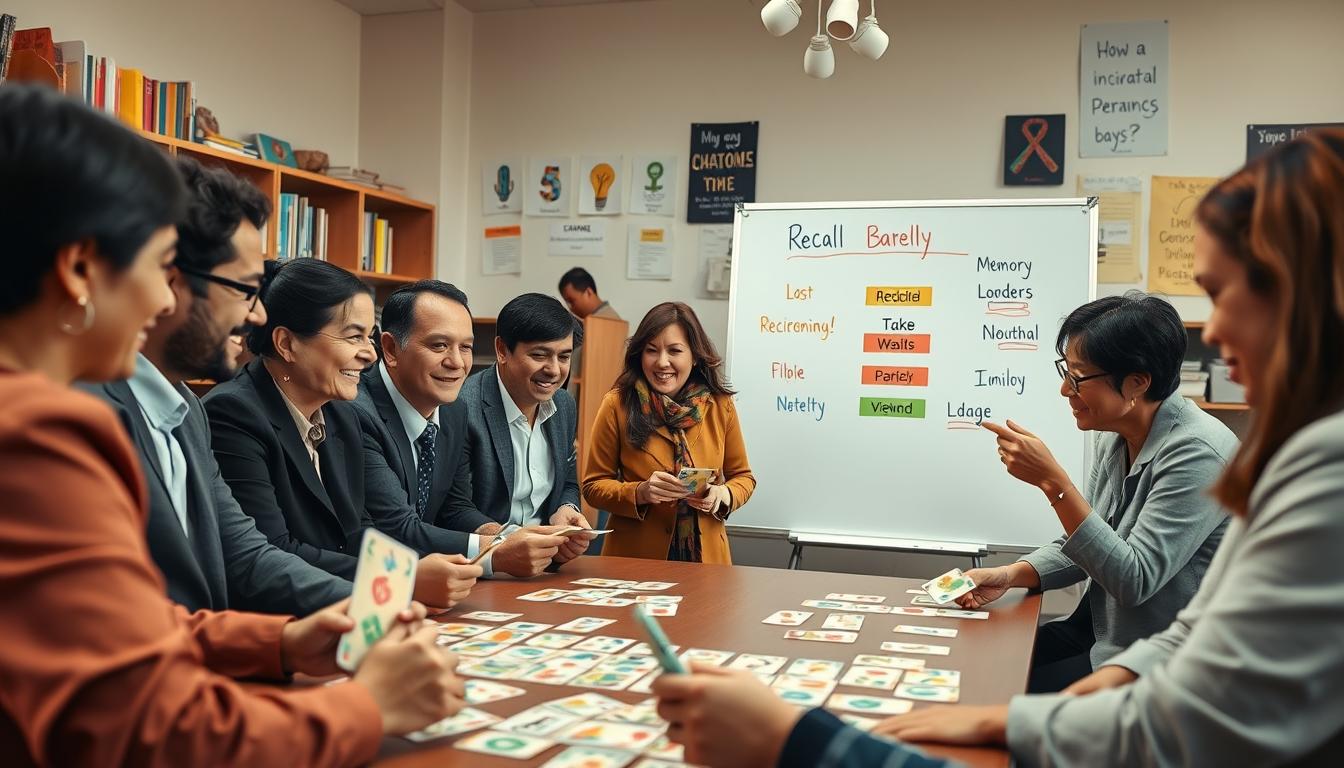
Small-group office games that build team skills and speed-thinking
Short office challenges open space for team members to show strengths and practice fast collaboration.
Lightning “Three Truths and a Lie” remix
Category-constrained truths
Set a category (travel, books, hobbies). Each person states three quick facts that fit the theme. One is false.
Limit responses to 20–30 seconds. That encourages focused recall and flexible thinking under a timer. Quieter members get equal turns and clear structure.
Stereotype Flip
Groups pick a shared trait and list common stereotypes fast. Then each item is immediately debunked with a short counterexample.
This activity exposes assumptions and builds perspective-taking. Keep rounds brief and non-personal to preserve safety.
Pass-the-Idea
One sentence per turn: add, refine, or pivot the concept, then pass every twenty seconds. Rotate starter, builder, and summarizer roles.
Use light scoring or no score to keep the focus on learning. End with a 60-second debrief: where did planning click? Where did communication stall?
- Rotate roles so members practice different contributions.
- Use prompts that let quieter people shine.
- Note strengths—ideation, synthesis, clarity—to inform task assignments.
Rapid association in remote teams: virtual-friendly activities
A brisk virtual activity can jolt a dispersed group into clearer, faster collaboration.
Try three quick formats that fit video calls and chat. Each one asks members to think fast, share clearly, and listen closely.
Emoji Pitch
Choose three random emojis and give a 30–45 second product pitch on video. This trains concise storytelling and creative links under a short timer.
QR/code clue chains
Share a sequence of QR codes or links that unlock tiny puzzles. Players follow clues to reach a final phrase. Use a shared doc so groups can track progress.
Micro scavenger prompts
Ask people to fetch an item from their desk that fits a category and explain it in 20 seconds. Quick rounds keep energy high and reduce screen fatigue.
- Platform options: chat threads for pitches, collaborative docs for chains, simple timers to keep rounds brisk.
- Use small breakouts to let more voices be heard and cut latency.
- Inclusion tip: avoid sensitive prompts and pick clues anyone can access at home.
| Activity | Round Length | Core outcome |
|---|---|---|
| Emoji Pitch | 30–45 sec | Concise messaging |
| QR/Code Chain | 3–7 min | Coordination, clue solving |
| Micro Scavenger | 20 sec per person | Fast association, rapport |
End rounds with a quick question like “Which surprising association worked best?” to lock learning and strengthen team cues on calls.
Brain training apps with fast association drills
Pick an app-driven sprint to practice fast linking, memory holds, and attention control between meetings.
Several popular apps deliver short, focused sessions that fit a busy day. These platforms target speed, working memory, task switching, and other core skills in quick bursts.
Lumosity, Elevate, Peak
Lumosity offers short routines that train processing speed, working memory, attention, and spatial skills. Peak and Elevate provide daily, personalized workouts that emphasize flexibility and speed.
NeuroNation, Happy Neuron, Fit Brains
These options focus on progressive word and logic bursts. They present clear levels, tracking, and short exercises to guide gradual development in memory and focus.
BrainHQ and CogniFit
BrainHQ uses neuroscientist-designed modules—Memory, Speed of Processing, and Executive Functioning—often in multi-week plans. CogniFit begins with an assessment and adapts drills to the areas you need most.
- Most apps allow quick sessions and reminders, so practice fits between calls.
- Example routine: three short rounds—speed, memory, flexibility—to sustain gains without fatigue.
- Compare interfaces, level progression, and how well each app matches your ability targets.
| App | Core focus | Best for |
|---|---|---|
| Lumosity | Processing speed, working memory | Daily warm-ups |
| BrainHQ | Speed, memory, executive function | Structured plans |
| CogniFit | Assessment-driven drills | Personalized training |
Use built-in dashboards to track information on progress and adherence. Small, regular sessions add up and support better thinking during team work and solo tasks.
Word and language sprints you can do anywhere
Use tiny language drills to shift thought quickly and warm up flexible thinking.
Micro-Wordle variants pack pattern practice into forty-five to sixty seconds. Try two-guess warm-ups: allow only two attempts and use feedback to refine a next guess. Or limit letters to a theme, like eco terms, to stretch domain vocabulary.
Speed Scrabble and solo Bananagrams
Build the fastest valid grid from a small tile set. Time completion, count valid words, or track letter usage efficiency.
Use one-minute rounds as a quick primer. Use five-minute sprints for deeper practice when you have more time.
Multiplayer twists and accessibility
Compare grids on a shared call or post screenshots in a chat thread for instant feedback. Agree on an acceptable dictionary first to avoid disputes.
| Variant | Round Length | Core measure |
|---|---|---|
| Micro-Wordle (two guesses) | 45–60 sec | Correct guesses, pattern use |
| Theme-limited letters | 1–5 min | Domain vocab recall |
| Speed Scrabble / Bananagrams | 1–5 min | Grid time, words formed |
Logic and pattern quick-hits to reset attention
A short puzzle burst can reset attention by demanding precise steps and fast decisions.
Use compact logic trials to practice rule application and fast elimination strategies. These exercises fit a two-to-three-minute window and return focused energy for the next task.
Mini Sudoku and KenKen races
Run 4×4 or 6×6 grids as timed sprints. Smaller Sudoku and KenKen puzzles train numeric reasoning and operational thinking while keeping setup minimal.
- Set a 2–3 minute cap and aim for clean solves, not rough guesses.
- Track completion time and mistakes in a simple log.
Nonograms and Minesweeper time caps
Nonograms (picross) encourage visual deduction. Fill rows and columns from numeric clues under a short timer to sharpen pattern spotting.
Minesweeper variants use fixed grids and brief timers to force probabilistic choices and fast inference.
Progress by shortening the timer or choosing denser puzzles. For small teams, start simultaneously and compare completion or error counts to add friendly pressure.
| Puzzle | Round time | Core skill |
|---|---|---|
| Mini Sudoku / KenKen | 2–3 minutes | Rule application, number sense |
| Nonograms | 2–3 minutes | Visual deduction |
| Minesweeper | 1–2 minutes | Pattern spotting, risk decisions |
Rapid team puzzles that reveal strengths and roles
Team puzzle sprints surface how people organize, bargain, and step into roles under pressure.
Use two quick team activities to learn about members’ natural roles and planning styles. Both require negotiation, trade-offs, and short timers so leadership, trade, and finishing tendencies appear fast.
Mixed-piece jigsaw scramble: negotiate, barter, and assemble
Divide the image into equal puzzles and give each group pieces others need. No group starts with a full set.
- Teams must bargain, swap, or trade time-bound favors to complete a picture.
- This reveals facilitators who coordinate, negotiators who trade, and finishers who assemble under pressure.
- Constraint ideas: no direct giving—only barter, or a two-minute cooldown on trades.
Task value sprint: combine numbers to hit goals under constraints
Give each person numbered cards. Teams combine numbers to reach preset goal totals before resources run out.
- Players decide whether to maximize overall goal value or share wins so all members contribute.
- Add rules like “no repeat combinations” or a 60-second round to simulate resource pressure.
- Five-minute math targets work as a quick version; longer play can add layered constraints and scoring tiers.
End both activities with a short debrief: which tactics worked, what trade-offs mattered, and which roles emerged. Use those takeaways to inform task allocation and cross-functional handoffs where negotiation and planning are routine.
| Activity | Round Length | Core insight |
|---|---|---|
| Mixed-piece jigsaw scramble | 5–10 min | Collaboration style; negotiation roles |
| Task value sprint | 3–7 min | Resource strategy; fairness vs. efficiency |
| Variation: quick math targets | 5 min | Fast planning and role clarity |
Executive function focus: match games to the skill you want to train
Choose one executive target and build a tiny exercise that trains that exact process.
For working memory: sequence recall and n-back prompts
Use short sequence recall rounds (number-letter-symbol). Add brief n-back style prompts to challenge holding and updating items.
Give instant feedback and log the longest correct sequence to track development.
For cognitive flexibility: rule-switch rounds and alternating categories
Run alternating-category timers or sudden rule switches under a buzzer. Force quick reconfiguration of rules and responses.
Track correct switches and how many seconds it takes to adapt.
For inhibitory control: timed turns and delayed responses
Introduce rules like “respond after a two-count” or “no immediate reply.” These constraints train pausing before action.
- Rotate emphasis across the week: memory Monday, flexibility midweek, inhibition Friday.
- Measure sequence length, correct switches, and fewer repeats as indicators of progress.
- After each round, reflect briefly: what helped planning and what blocked fast thinking?
| Executive area | Example drill | Metric |
|---|---|---|
| Working memory | Number-letter sequence, 2-back | Max sequence length |
| Cognitive flexibility | Category switch, rule flip | Correct switches per round |
| Inhibitory control | Delayed response turn rules | Reduced premature replies |
Timing and levels: structure sessions to fit the workday
Plan short and longer sprints so practice supports focus instead of stealing it.
Structure helps teams and individuals treat practice like a predictable part of the day. Short, regular practice works best: it fits between tasks and sustains morale without disrupting flow.
Five-minute micro-sessions
Use micro-sessions as quick resets after meetings or before small tasks. These 5-minute rounds break inertia and revive attention.
Template: one micro-session right after a stand-up or meeting. Keep rules simple—no repeats and a visible timer.
Fifteen-minute deep sprints and progression
Fifteen-minute sprints suit complex prep, planning, or team problem solving. They allow richer feedback and measurable learning.
Progress by adding one constraint at a time: introduce a delayed response, widen category distance, or shorten the time. Track a clear goal—add one correct link per minute or increase sequence length by one each week.
- Differentiation: micro on Mon/Wed/Fri; deeper sprint on Thursday.
- Stepwise difficulty: add one new rule per level to avoid overwhelm.
- Make sessions calendar items so they survive busy days.
| Session type | Minutes | Best fit | Progression idea |
|---|---|---|---|
| Micro-session | 5 | Quick reset after meeting | Add one constraint (no repeats) |
| Deep sprint | 15 | Pre-task planning, team practice | Shrink time or increase category distance |
| Mixed cadence | 5 & 15 | Weekly balance for teams | Raise level every two weeks; small number targets |
At work and at home: integrating games into routines without disruption
Small, planned play pockets can nudge focus and make transitions smoother during a busy day.
Start by adding predictable, tiny sessions that fit existing blocks. This helps people plan cognitive load and avoid interrupting deep work.
Morning primer: a two-minute category switcher before email or meetings cues attention. It’s fast and sets a clear start to the work day.
Lunch reset: use an emoji pitch or a short word chain to re-energize without stretching break time. These quick activities refresh mood and can be done alone or in small groups.
Late-afternoon refocus and rotating lightning rounds
Late-afternoon refocus: run a mini logic round to clear clutter and ease the transition to end-of-day tasks.
Rotate “show and tell” lightning rounds so each team member gets 60 seconds to share a tool or tip. This builds inclusion and cross-pollinates useful habits.
- Keep timing predictable so members can plan their day and avoid surprises.
- Use opt-in facilitation and offer an opt-out to respect comfort and psychological safety.
- Capture one quick takeaway per session to turn short experience into routine planning ideas.
- Bridge to home life with solo variants people can play with family or roommates.
| Moment | Example activity | Benefit |
|---|---|---|
| Morning | 2-min category switcher | Faster focus before meetings |
| Lunch | Emoji pitch / word chain | Quick re-energize, social boost |
| Late afternoon | Mini logic round / show-and-tell | Refocus, idea sharing, planning |
Rules that keep games inclusive, safe, and motivating
Clear norms make brief sessions feel fair and friendly for everyone.
Set an opt-in norm so people can pass without feeling pressured. This protects psychological safety and keeps participation voluntary.
Use non-sensitive prompts that never ask for private details. Pick neutral themes so all members can join comfortably.
Simple visible rules and timing
Post short rules where everyone can see them. Run a one-round practice so members understand the flow before scoring starts.
Use a visible timer to set fair turn lengths. When time is consistent, people know what to expect and can relax into play.
Celebrate effort; invite low-stakes options
Frame scoring as friendly feedback and praise creative risks and effort. Rotate facilitators so influence is shared across the team.
Offer quiet participation modes, like chat replies, and end rounds with open questions about clarity and comfort rather than performance.
| Rule | Why it matters | Quick tip |
|---|---|---|
| Opt-in participation | Protects comfort and consent | Allow a single pass per round |
| Non-sensitive prompts | Prevents exclusion | Use neutral themes only |
| Visible timer | Sets clear expectations | Display on-screen or phone |
| Rotate facilitation | Shares ownership | Switch facilitator each session |
From play to performance: connect skills to real tasks
Turn short practice into clear signals about how work actually gets done.
A two-minute pairing of quick prompts can surface how a team tackles real work under pressure. Those moments show who prioritizes, who clarifies goals, and who slows the group to check accuracy.
Translating practice to planning, communication, and problem solving
Link fast association to planning by noting how rounds speed prioritization and smooth switching when project requirements change.
Tie concise prompts and short answers to clearer updates in standups and stakeholder briefings. Teams that practice crisp replies hand off tasks with fewer questions.
Map logic micro-hits to problem solving under uncertainty: quick pattern detection points to viable options faster than long deliberation.
Reflect brief: what improved—speed, accuracy, or collaboration?
Capture quick metrics—round speed, error rate, or collaboration notes—to see which dimension is moving.
- Ask targeted questions: “Did speed or accuracy improve more today?” and “Where did collaboration feel strongest?”
- Use one example: a team that improved category switching sped up cross-functional handoffs in sprint planning.
- Translate strengths into roles: rapid synthesis for scrums, methodical accuracy for QA tasks.
Consistent practice is the lever that moves these abilities from exercise into everyday task performance. Track small wins and adjust goals to support ongoing development.
Conclusion
Conclusion
Two- to five-minute association sprints offer a practical way to break autopilot and prime focused action. This short list gives solo, pair, and team options that fit real calendars and tight constraints.
EF literature stresses that regular, pleasant practice strengthens attention, memory, flexibility, and impulse control. The main benefit is consistency: small, repeated bouts beat occasional marathon sessions.
Start with one accessible format today and layer options as confidence grows. Pair in-person rounds with an app routine to reinforce gains between sessions. Keep play inclusive and fun, celebrate progress, and schedule the next five-minute session to make the habit stick.