Mental discipline games for adults undergoing military-style routines to strengthen cognitive control

Can a short, methodical drill change how you think under pressure and help you perform better today?
The guide that follows is a practical roadmap for people pursuing military-style routines who want to pair structured play with physical work to build cognitive control and lasting strength.
Consistency beats spectacle: five- to ten-minute EMOM “death by” sets, static holds like plate overheads, and targeted endurance tests boost core stability and upper- and lower-body endurance while teaching focus under fatigue.
Short mindfulness drills and tactical breathing are woven into each session to improve attention, impulse control, and pain tolerance. This approach favors sustainable gains and steady workout adherence over risky one-off gut checks.
Expect scalable drills, selection tips, and simple tracking methods—time-under-tension and perceived exertion—to measure both physical progress and control of the mind in the present.
Why mental discipline matters in military-style training right now
When preparation windows are tight, focused practice becomes the edge between passing and falling short.
Across SEAL, Ranger, and other special forces selections, candidates face short timelines and brutal assessments. Regular mental work underpins marksmanship, academics, and physical tasks. It turns hard workouts into reliable performance.

Brief, structured practice reduces attention lapses that cause most breakdowns. Studies with service cohorts show short mindfulness sessions cut errors and improve situational awareness during volatile events.
“Most failures are failures of attention, not of strength.”
- Define the skill that converts fitness and technique into steady results during stress.
- Link routine practice to resilience and steady motivation through plateaus.
- Explain how focused routines save time by reducing decision fatigue and anchoring workouts.
- Show that these methods scale from entry-level candidates to special forces hopefuls.
Intentional practice guides the body during high-effort bouts by pacing, preserving technique, and keeping execution consistent under pressure.
Safety first: building toughness without crossing the injury line
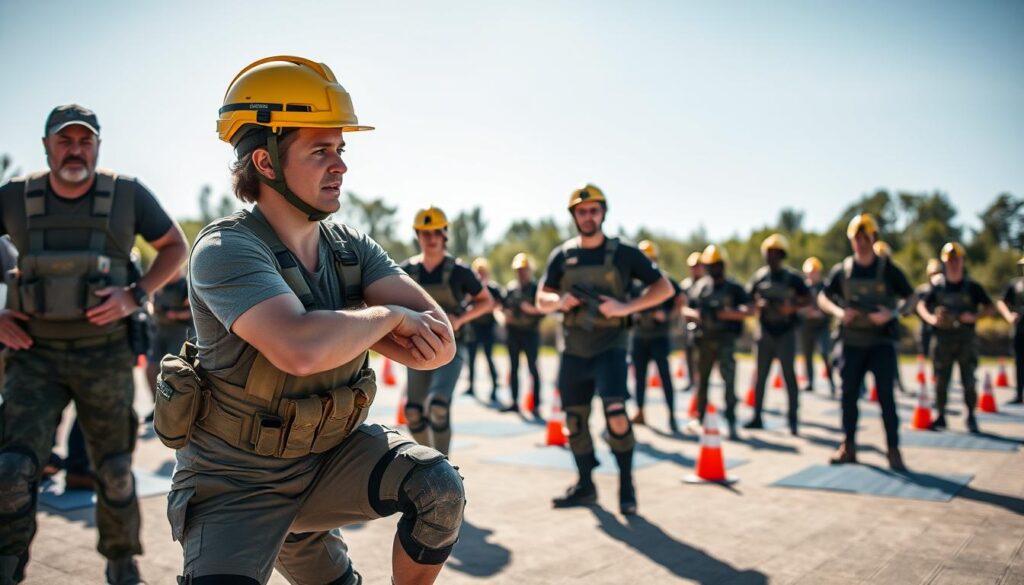
Toughness pays off only when it keeps you training; reckless pushes cost weeks on the sidelines. Set clear limits so each session builds strength and resilience without breaking the body.
Progressive overload and weekly volume targets
Establish gradual increases in volume and intensity week by week. Use simple targets: small load or mileage jumps that accumulate safely.
- Follow progressive overload standards that protect tissue and boost long-term strength.
- Prefer steady weekly mileage—the five-week approach (25 miles per week) often beats one extreme event that causes rehab time.
- Structure sessions with a clear purpose, appropriate load, and planned recovery.
Red flags and pain vs. harm: when to push, when to pause
“There is a fine line between mental toughness and stupidity.”
Teach athletes to read stress that signals adaptation versus pain that signals harm.
- Red flags: sharp joint pain, altered mechanics, swelling, or pain that lasts beyond 48 hours.
- When flagged, deload, substitute lower-impact work, and address weaknesses early in a cycle.
- Use smart constraints—time caps and rep targets—to train grit without unnecessary risk.
Protecting training continuity is the best toughness strategy for candidates who want steady progress and fewer setbacks.
The daily grind: consistency routines that harden focus and resolve
A fixed training time turns chaotic effort into steady progress you can count on.
Pick a show-up slot that fits your life—early morning, lunch, or after work. Locking that time makes practice automatic and frees willpower for quality work.
Set training “show-up” times
At home, follow a short pre-session ritual: hydrate, two minutes of breath focus, and quick mobility. This primes attention and reduces setup friction.
“Start the warm-up and commit to the first five minutes; action dissolves doubt.”
- Train outdoors sometimes to simulate real-world conditions while keeping the same schedule.
- Track a daily streak with three checkpoints: warm-up, main sets, cool-down.
- On low-motivation days, do a minimal session—short EMOM or mobility circuit—to protect momentum.
Consistency compounds: small, reliable efforts across days smooth effort and add steady strength over time. The goal is repeatable execution, not perfection. A set show-up time is a simple way to lower decision fatigue and keep focus where it matters.
Mental discipline games for adults in military training
Quick, structured sessions teach pacing and calm when fatigue starts to bite.
Choose drills by time, space, and kit. If you have five to ten minutes, pick an EMOM. Tight quarters favor static holds or mountain climbers. When plates or a pull-up bar are available, add load or vertical pulls to increase strength and stress control.
How to choose by constraints
If time is limited, do a 5–10 minute EMOM. If space is tight, use wall sits, planks, or mountain climbers. If equipment exists, add a plate, sandbag, or bar for progressive overload.
Scaling by level
For candidates, lower reps, extend rests, or drop weight. For special forces athletes, increase reps, reduce rest, or add isometric pre-fatigue. Log reps per minute and perceived exertion to guide progression.
| Constraint | Suggested Drill | Scale Up | Scale Down |
|---|---|---|---|
| 5–10 min | EMOM (push-ups, pull-ups) | +1–2 min weekly | Lower reps per minute |
| Tight space | Plank / Mountain climber | Add intervals | Shorter rounds |
| Equipment | Plate overhead hold | Increase weight | Use backpack weight |
Example: start with a 5-minute EMOM at manageable reps, add one to two minutes each week until you hit the target. Keep movement standards strict—quality under fatigue trains the mind as much as the body.
EMOM “death by” classics: short, intense tests of control
A short, structured EMOM can expose weak links and sharpen composure on the clock. This format turns every minute into a precise test of pacing, form, and calm.
Death by Push-Ups and Plank
Hold a plank or top-of-push-up position for 5–10 minutes. Each minute do 10 push-ups, then return to the hold without breaking form.
Death by Pull-Ups with Burpees or Mountain Climbers
Keep a continuous burpee or mountain climber pace for 5–10 minutes. Pause only each minute to complete 5–10 pull-ups.
Death by Wall Sit with Squats
Hold a wall sit for 5–10 minutes. Every minute step out, do 10 squats, and resume the sit to build lower-body strength and grit.
Ten-minute Plate Overhead Holds
Hold a 45-pound plate, barbell, or sandbag overhead for up to 10 minutes. If needed, lower each minute, reset, then return overhead and build toward an unbroken hold.
| Drill | Structure | Scale Up | Scale Down |
|---|---|---|---|
| Push-Ups + Plank | 10 reps/min with continuous hold | Increase reps or minutes | Reduce reps to 5/min |
| Pull-Ups + Burpees/Mountain | 5–10 pull-ups each minute | Add pull-ups or reduce rest | Swap burpees to mountain climbers |
| Wall Sit + Squats | 10 squats each minute from sit | Heavier load or longer hold | Shorter hold intervals |
| Plate Overhead | Hold up to 10 minutes | Increase weight | Lower weight or break every 2 minutes |
Coaching notes: cue neutral spine, braced midline, steady breathing, and controlled tempo. Start modest, log completed minutes and reps, and progress by small weekly increments to keep the challenge useful and safe.
Mindfulness and tactical breathing to stay present under stress
Short breathing skills and brief attention drills can reset your body and sharpen decisions under pressure. These tools train present-focused attention without judgment and improve sleep, blood pressure, and impulse control.
Five-minute attention drill to train impulse control
Sit tall for five minutes. Breathe naturally and keep your attention on the breath.
When distraction appears, note it briefly and return to the present. Repeat daily to grow the prefrontal capacity that supports decision-making.
Box breathing to downregulate between intervals
Use 4-4-4-4 box breathing between hard sets. It slows heart rate and restores focus fast.
One minute before a marksmanship string or after a ruck segment calms arousal and improves fine-motor control.
Applying practice to real tasks
- Benefits: better composure during evaluations, steadier aim, and less mind-wandering on long marches.
- Log minutes practiced, a pre/post stress rating, and notes on focus quality to track gains.
- Start with five minutes daily and add one minute before sessions to boost recovery and resilience.
Long-duration challenges that stretch resilience without derailing training
Sustained challenges show whether your weekly work truly adds up or just burns you out. Use long events to test pacing, fueling, and mental stamina, not to catch up on missed months.
Spec Ops Triathlon example
The Spec Ops Triathlon is a nonstop sequence: run 4–5 miles, ruck 4–5 miles at planned weight, then swim 1–2 miles with fins. This example layers modes to test pacing and transition strategy while keeping the sequence short enough to limit unnecessary wear.
Five-week race vs. one big day
Coaches favor the five-week race: accumulate 25 miles per week for five weeks rather than attempting an unprepared 100-mile weekend. Steady miles build endurance and strength with far less risk of injury and missed time.
- Readiness checkpoints: consistent weekly miles, regular ruck sessions at target weight, and practiced fin-swim intervals before attempting the full sequence.
- Time & fueling: plan split times per segment, test hydration, electrolytes, and carbs on training runs to avoid surprises on event day.
- Load progression: increase ruck weight and distance in small steps to grow tissue tolerance without sacrificing technique.
- Motivation tactics: break sessions into time-based blocks with breathing resets to manage pain and keep focus.
- Recovery: prioritize sleep, light mobility, and easy aerobic flushes after the event to preserve fitness and strength gains.
- Debrief: log segment times, perceived pain, pacing accuracy, and nutrition outcomes to refine the next cycle.
“Long events are a test of planning as much as power.”
Integrate these challenges only during phases when the weekly load can absorb them. With proper prep and measured progression, long-duration work boosts endurance and motivation without derailing overall fitness.
At-home and low-equipment options for busy people
A ten-minute circuit in the living room can maintain strength and strengthen attention. These short EMOMs and static holds fit tight schedules and small spaces.
Living-room circuits: planks, wall sits, EMOMs in minutes
Try this compact template: 10 minutes alternating 30-second plank holds and 30 seconds of mountain climbers. Keep a neutral spine and steady breathing to build core stability and focus.
Wall sit + air squat sessions work well when you need lower-body stamina. Do three rounds of 2 minutes wall sit, then 1 minute air squats. Measure in minutes, not reps, to train pacing and posture.
Use a backpack or sandbag as a safe substitute for plate overhead holds or front-loaded carries. Start light and add small weight increments over weeks.
“Small, repeatable sessions keep progress rolling when life gets busy.”
Practical tips: pick two to three things—one hold, one movement, one breath drill. Schedule brief workouts around work and family commitments. Add one minute weekly or a few extra reps to keep growth steady without long time demands.
Programming your week: balancing strength, endurance, and mind training
A balanced weekly layout makes hard sessions count while protecting recovery and family time.
Sample week: workouts, recovery days, and mindfulness minutes
Use this simple structure to guide one week of work.
- Day 1 — Heavy strength: prime muscle groups when you are freshest.
- Day 2 — Easy aerobic or ruck and 5–10 minutes mindfulness after warm-up.
- Day 3 — Skill or heavier single-lift work plus tactical breathing between sets.
- Day 4 — EMOM discipline session (short, focused) and light mobility.
- Day 5 — Longer endurance segment after proper prep; keep pace conservative.
- Day 6 — Active recovery: mobility, light aerobic, and breath practice.
- Day 7 — Rest or a short home circuit to protect the consistency streak.
Integrating family, work, and coach feedback loops
Set a realistic daily time budget so workouts fit life, not fight it.
Use at-home options when schedule clashes with family plans. Track sessions and share notes with a coach weekly.
Review trends, adjust loads, and plan recovery days to keep progress balanced across strength, endurance, and attention skills.
Tracking progress: measuring control, focus, and endurance
A simple log can turn vague effort into measurable progress across focus and endurance. Keep entries brief and repeatable so you can compare weeks without guesswork.
Time-under-tension, lapses in attention, and perceived exertion
Record total minutes in holds (planks, overheads) and note quality of each rep. Track weight and rep quality to see true gains in strength and endurance.
Log any lapses in attention during tasks—moments you drift from the present. Aim to cut those episodes week over week through short daily practice.
- Capture minutes completed, time-under-tension, and rep quality to measure control under fatigue.
- Note weight used and rate of perceived exertion to balance stimulus and recovery; flag pain beyond normal soreness.
- Use fixed-interval EMOMs to assess endurance: steady outputs across minutes show better pacing and force control.
- Track level markers (reps per minute at steady RPE) rather than one-off spikes that risk form breakdown.
After each workout, write one line on mind wandering, breath control, and presence. Plan a single micro-adjustment for the next session. Reassess benchmarks every two to four weeks to ensure strength, endurance, and attention progress together.
Resources and next steps for candidates and coaches
Good resources turn scattered effort into a clear path you can follow week to week.
Start with two evidence-backed hubs. Military.com’s Fitness Section (Stew Smith and contributors) offers structured workouts, recovery guides, nutrition notes, and motivation pieces that support strength and fitness work.
For mental skills and stress tools, HPRC’s Performance Psychology section provides mindfulness, tactical breathing, progressive muscle relaxation, and autogenic training resources tailored to military settings.
Where to find workouts, recovery protocols, and skill drills
- Build a personal resource library: template EMOMs, long-duration checklists, breath scripts, and recovery playbooks aligned with your phase of work.
- Map progressive blocks: plan miles, ruck loads, and swim sessions with scheduled deloads to reduce injury risk for special forces candidates.
- Pair short daily practice with focused sessions to lock in attention and composure under stress.
- Keep the benefits front of mind: integrating mental skills with physical fitness amplifies carryover to selection tasks.
- Set a team workflow where athletes share session notes with coaches to improve programming and recovery decisions.
“Track simple metrics, update resources regularly, and let small, consistent practice compound into reliable performance.”
Action step: pick one article from Military.com and one protocol from HPRC this week. Save them to your library, adapt one EMOM and one breath drill, and test over two weeks. Review progress and update resources quarterly to keep practice current and evidence-informed.
Conclusion
Small, repeatable drills and measured overload are the surest way to build resilience and steady performance. This way favors progress over spectacle and keeps you healthy enough to train again tomorrow.
Start today with a short EMOM and a five-minute breath routine. Do one simple habit each day that fits your life and builds momentum.
Resist the urge to chase one big event. True gains come from steady work, not rare heroics. Choose one practical challenge to attempt this week and one habit to lock in at home.
Show up, execute the plan, and let motivation follow action. Keep the process simple, measurable, and repeatable so each day moves you closer to your goal.