Logical-filtering games for adults who have difficulty ignoring non-essential data
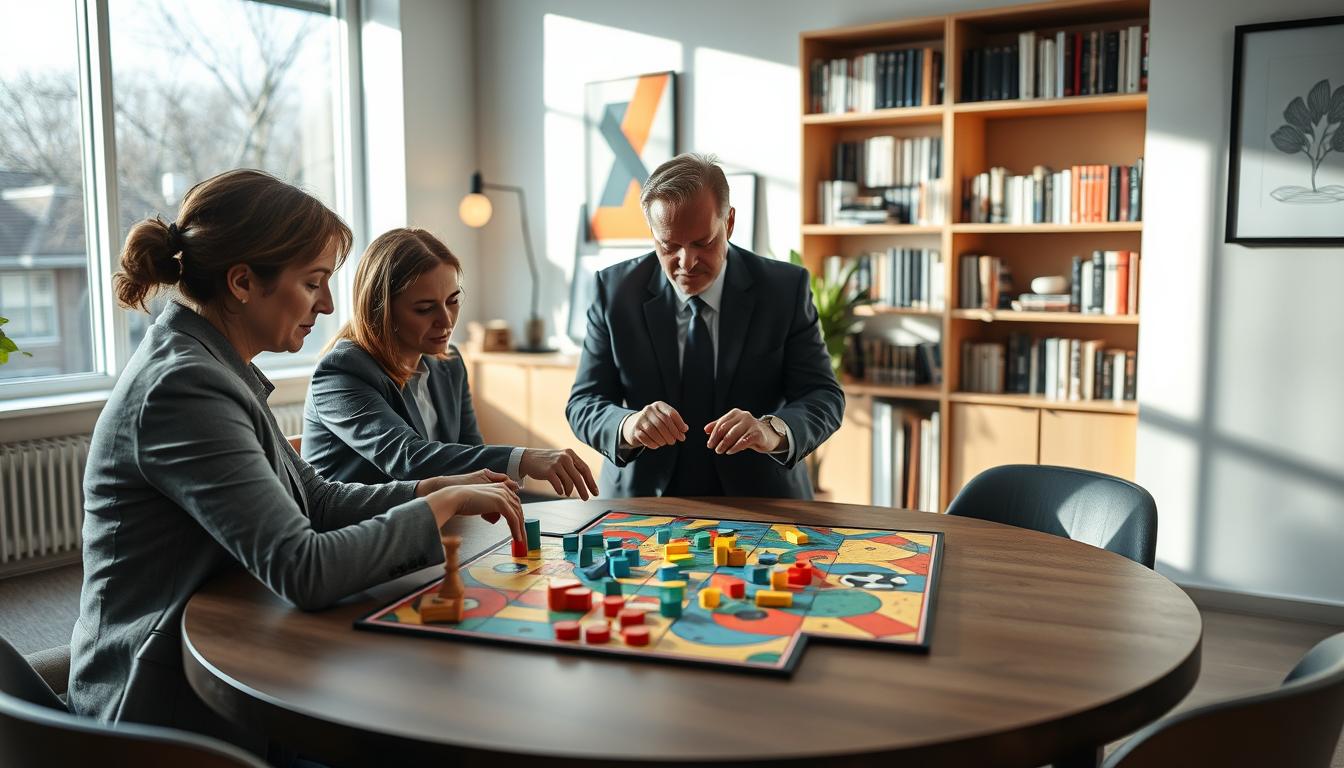
Have you ever felt buried in facts and wished a simple practice could sharpen judgment fast?
This guide promises practical steps that turn structured play into clearer thinking. It shows how rules and direct feedback help separate signal from noise during quick decisions.
We’ll define how focusing on the right information at the right time helps you infer each role, reject distractions, and protect working memory. The idea is to make roles and cues explicit so you can act faster and more accurately.
The approach moves from simple rules to applied strategy: add mild uncertainty and timed turns, then practice across problem scenarios. You’ll learn a repeatable plan to boost performance in meetings, day planning, and routine work tasks.
Expect measurable results—shorter decision time, fewer errors, and higher-quality outcomes—so play sessions translate to real gains in life and jobs.
Understanding the challenge: why irrelevant details derail adult focus
Too much incoming information can grind decision-making to a crawl. It floods working memory with small facts and cues, making it hard to spot what is role-relevant right now.

When too many inputs arrive, a cognitive bottleneck forms. The brain must choose which signals to hold and which to drop. That makes reacting to loud but low-value stimuli more likely.
“Loud” notifications or side conversations often drown out quieter, important data, biasing attention toward the wrong things.
Profiles with attention deficit or adults adhd face greater distractor inhibition and shifting problems. This is a mental health issue, not a matter of willpower.
- Email triage
- Multi-topic meetings
- Parallel tasking at work or home
Clear goals and constraints reduce load. If you assign a role to each incoming piece of data, you cut switching costs and lower fatigue. That sets up the need for practice systems that simulate noisy conditions and train prioritization.
| Cause | Typical effect | Practical fix | Benefit |
|---|---|---|---|
| Unscoped instructions | Chasing low-value detail | Define a single role per task | Faster decisions |
| Multiple simultaneous cues | Bottlenecked working memory | Apply hard constraints | Less switching |
| Loud, salient distractions | Bias toward noise | Mute or schedule interruptions | Better focus |
How logical-filtering games build signal detection skills
Structured exercises let you turn noisy inputs into clear, decision-ready signals. Rules and immediate feedback make it easy to treat each cue as either helpful or discardable.

From rules to results: reducing entropy through structured play
Start with short, turn-based puzzles that give a single goal and a few constraints. Each move reveals patterns and shrinks the hypothesis space.
As you add limits, the information you keep becomes more predictive and random noise fades. Time-boxed turns teach you to pick the one task with the highest information impact.
- Follow clear steps that map cues to a single role or task.
- Record assumptions and mark contradictions during training.
- Debrief briefly: note decisions that would change under a stricter structure.
Ask every turn: “Does this input change my decision?”
| Training phase | Key action | What it trains | Short practice |
|---|---|---|---|
| Initial puzzles | Follow fixed rules | Role inference, pattern spotting | 5–10 minute rounds |
| Added constraints | Limit allowed moves | Prune hypotheses, boost precision | 10–15 minute sessions |
| Timed uncertainty | Short, pressured turns | Prioritize high-impact cues | 3–5 minute bursts |
Consistent short sessions and focused debriefs build a habit: track patterns, ignore superseded signals, and adjust hypotheses only when new information materially changes the state.
A research-informed framework: constraints, evidence, and information gain
A research-backed model turns dialogue and events into clear decision rules. It separates non-negotiable facts from soft claims so you know what to trust next.
The approach maps inputs into four classes: evidence, phenomena, assertions, and hypotheses. Hard constraints (evidence and phenomena) remove impossible roles. Soft constraints (assertions and hypotheses) add probabilistic weight to remaining options.
Hard vs. soft constraints: pruning impossibilities versus weighting likelihoods
Treat verified evidence as non-negotiable. Use it first to prune candidates and cut the search space.
Then treat assertions as graded signals. Give them weights that shift probabilities rather than override facts.
Information gain as a training cue for better decisions
Information gain links each hypothesis to expected uncertainty reduction. Pick the next action that most reduces entropy in the least time.
“Choose the move that clarifies outcomes fastest, not the one that feels most certain now.”
Mapping real-time updates to attention strategies
Recompute the leading hypothesis as new evidence arrives. Keep alternatives alive to avoid premature commitment.
- Prune impossible assignments using hard facts.
- Score remaining hypotheses with weighted soft claims.
- Normalize scores to get calibrated posteriors and pick a MAP role.
- Repeat each turn as new data comes in.
The paper’s solver returned calibrated posteriors and better results than LLM-only baselines across public datasets. That shows an interpretable, training-free process can outperform opaque models and still boost them when used as a reasoning tool.
Designing your environment for success
Control over setting and schedule makes practice less effortful and more effective.
Start by reserving short blocks of uninterrupted time. Plan 15–25 minute sessions so you build habit without burning focus.
Define a quiet space and remove anything that tempts switching. Hide unrelated apps and keep only task-relevant tools in view.
Simple rules to protect attention
Apply one primary and one secondary tasks limit. This keeps your mind from fragmenting across competing goals.
Use a visible timer and a single written “next action” line. When drift happens, the timer and note restore momentum with no extra decisions.
Park stray thoughts on a “noise bucket” page so they do not hijack the session.
| Setup element | Action | Benefit |
|---|---|---|
| Reserved blocks | 15–25 minute daily slots | Boosted focus, less fatigue |
| Workspace | Surface only relevant materials | Fewer context switches |
| Distraction control | Notifications off, single-tab rule | Higher information quality |
| Tracking | Percent of session on target task | Measure performance over weeks |
After each session, note one tweak that would improve focus the next day. Small changes accumulate and lift overall work outcomes.
Getting started: a four-week how-to program to improve logical filtering
Begin with a compact, practical month-long plan that turns short practice into clearer decision habits.
Week one focuses on simplifying tasks and rehearsing core rules. Pick one turn-based puzzle with transparent rules and write them down. Do short daily sessions that emphasize one role at a time to lower memory load.
Week one: simplify tasks and rehearse core rules
- Limit each session to three puzzles.
- Note one filtering decision per puzzle and one time saved.
- Keep a tiny note template: rules, hypothesis, disconfirming evidence, next step.
Week two: add soft constraints and competing cues
Introduce misleading patterns and extra options. Practice labeling cues as hard or soft and assign a confidence score.
This trains weighting without letting soft inputs override verified facts.
Week three: increase uncertainty and timed turns
Randomize layouts and add timed turns to simulate pressure.
Track decision latency and error types so time pressure sharpens, not breaks, your role reasoning.
Week four: transfer strategies to work and daily life
Before a meeting or task list, write hard constraints (agenda, deadlines) and soft inputs (opinions).
Pick the action with the highest information gain and use a daily reflection to capture one carryover strategy to your day work.
- At month end, evaluate: shorter decision times, fewer context switches, higher first-attempt accuracy.
Small, consistent steps produce measurable change in how you process noise and pick the right next action.
Choosing the right genres: puzzlelikes that emphasize structure over noise
Genre choice guides practice: some titles reward systematic moves, others reward curiosity.
Prefer puzzles that make rules visible and state changes predictable. These titles reduce distracting flair and highlight the information you need to prune options.
Sokobanlikes and turn-based planners for clean signal
Sokoban-style and turn-based planners force you to think in discrete steps. Grid movement, limited actions, and clear goals expose patterns in state transitions.
- They make roles explicit: what can move, when, and why.
- They reward planning over trial-and-error.
- Example titles: Sokoban, Stephen’s Sausage Roll, Snakebird, Cosmic Express.
When “secret box” titles help—and when they hinder
Secret-box experiences like The Room or Monument Valley restore curiosity and calm. They lower anxiety and boost exploration.
But they can train random poking more than systematic filtering. Pattern discovery only helps when it links to predictable outcomes; otherwise it becomes noise.
Match your preferences to your training goals. Try an 80/20 rotation: 80% structure-first play to build filtering skills, 20% secret-box play for variety and motivation.
Social deduction as a filtering lab: roles, assertions, and hypotheses
Social deduction tables make an ideal lab for practicing how to sort facts from spin.
In Avalon and Mafia, a constraint-satisfaction approach maps events and dialogue into four classes: evidence, phenomena, assertions, and hypotheses.
Practicing role inference under deception without losing focus
Use a short routine each round. Mark evidence and phenomena as hard constraints, and log assertions and hypotheses as soft inputs with confidence scores.
Only update a role likelihood when new cues change the math. That discipline prevents social momentum from pushing you to a premature assignment.
Tracking evidence versus chatter in group play
Apply research-backed steps: prune impossible role assignments with hard facts, then score remaining role options using weighted soft constraints tied to information gain.
- Record hard constraints first.
- Log assertions with confidence levels.
- Choose actions that maximize information gain, such as targeted questions or focused votes.
The referenced paper shows this approach yields calibrated posteriors and MAP role predictions that beat LLM-only baselines. Use that framework to make an auditable trail: note why a claim is weak or strong.
- Keep multiple hypotheses alive; avoid early commitment.
- Use short turns to limit rumination and force clear choices.
- Track role prediction accuracy across sessions to measure progress.
Focus on the next question that yields the biggest clarity leap, not the loudest voice in the room.
Games that train pattern recognition without overwhelming working memory
Choose puzzles that keep the visible state small and make the useful pattern obvious. This helps your memory focus on what changes the outcome, not on decorative details.
Prefer turn-based, single-screen problems with short time per move. They map each action to a clear role in the solution and limit information processing demands.
Begin with one concept per level and add constraints gradually. Use a sticky note to externalize rules and mark applied rules each turn so working memory stays free for active decisions.
After mistakes, pause and ask, “Which pattern did I trust that the rules didn’t support?” Log pattern templates that reliably predict progress and rehearse them before a session.
- Keep sessions short: ten to twenty minutes.
- Track simple metrics: retries per level and solve time.
- Drill problem types that cause slips, then return to calmer levels to consolidate learning.
| Design feature | Why it helps | Example |
|---|---|---|
| Single-screen puzzles | Limits moving parts and memory load | Sokoban-style block pushes |
| Short turns | Encourages quick role mapping per action | Turn-based planners, 30–90s moves |
| Visible rules | Aligns patterns with legal moves | Levels that show goal and constraints |
Logical-filtering games for adults who struggle with irrelevant details
Good practice begins by matching a system’s pace and feedback to the skill you want to build. Pick titles where rules are consistent and feedback is immediate so each action teaches a clear lesson.
Align play with your preferences, but keep the core strategy tight. Favor systems that reward intent over flashy displays so results reflect skill rather than luck or hidden triggers.
Test a candidate with a 10-minute trial. Ask: does each move change the state in a transparent way? If not, discard it for training purposes.
Practical checklist
- Consistent rules density and clear subgoals to decompose tasks.
- Undo or pause options to allow short reflective windows.
- Visible error states that map mistakes to rule breaks.
- UI that minimizes pop-ups and distracting animations.
Label objects or moves (blocker, enabler, connector) to build a reusable mental model.
| Selection factor | Why it matters | Quick test | Benefit |
|---|---|---|---|
| Rules density | Predictable mapping from action to outcome | Play 10 minutes to see if rules repeat | Faster pattern learning |
| Feedback clarity | Immediate error signals speed correction | Check if mistakes show cause-effect | Better transfer to work tasks |
| Pace and controls | Deliberate tempo favors reflection | Verify pause/undo exists | Safer skill rehearsal in short time |
| UI noise level | Less distraction = clearer information | Scan for pop-ups and flashy effects | More reliable in-session results |
Keep a shortlist of go-to titles that pass these checks. Use them before meetings or planning sessions so learning transfers directly into work within the same day.
Step-by-step practice: turning noisy information into actionable cues
Make every decision a small experiment that tests one claim and trims uncertainty fast.
Adopt a repeatable process that forces clarity. Start each turn by listing hard phenomena and verified evidence. Then label assertions and hypotheses so you separate fact from speculation.
Identify phenomena, label assertions, and score hypotheses
Write short justifications for each cue. Use a simple likelihood scale (10 / 50 / 90) to avoid false precision.
Use likelihood notes and confidence ratings each turn
- State the immediate task in one sentence.
- List hard facts first, then label softer claims.
- Pick one action that best reduces role uncertainty and note the expected learning.
- Record a confidence rating and the assumption that would change your mind.
- After the move, mark whether role clarity rose or fell and refine your cue rules.
Keep a short “common traps” list and rehearse countermeasures before sessions. Over time, shrink annotations to keywords so the steps stay light and repeatable.
Advanced scenarios: extracting signal from complex systems
Complex simulations expose how shifting rules force constant hypothesis updates under time pressure.
Reading evolving rules, roles, and AI behaviors under pressure
Use Dwarf Fortress as an example: recent updates (53.01–53.06) added siege actions like building stairs, breaking constructions, and bringing battering rams.
Those changes alter pathing and role capabilities. They require players to re-weight cues and treat patches as development data.
Adopt a short control routine for high-pressure sessions.
- Write a one-line state summary.
- List hard constraints affected by the patch (construction breakage, new pathing).
- Pick the next action with the highest expected information impact.
Focus on systems-level patterns: how behaviors chain, not every incidental event. Use maps and overlays to externalize space and hidden dependencies.
Pause for structured review points to stop cascading errors when the environment shifts rapidly.
Treat each change log as new evidence that updates your prior; then run the decision checklist again.
| Scenario | Key change | Immediate action | Tracked result |
|---|---|---|---|
| Siege AI adds stair-building | New paths through walls | Re-evaluate choke points; reposition defenses | Reduced breach rate |
| Operators control siege engines | Manual targeting available | Assign operator roles; monitor engine status | Higher damage control, clearer roles |
| Pathing optimizations | Bugs fixed in support groups | Test assumptions in small trials; update role map | More reliable route predictions |
In work contexts, document moving rules—policies or tool changes—and schedule quick reviews. Track expected versus actual results after each update to refine your model.
Adapting strategies for adults with attention deficit hyperactivity disorder
A short, structured routine helps shield working memory and keeps practice effective.
Keep sessions short and rule-first: 15 minutes active, 5 minutes break is a reliable starting point. Use an external timer and one-goal card so the next move is obvious when focus drifts.
Anchor attention with visual checklists that separate hard versus soft constraints. People adhd respond well when cues are visible and binary: keep or discard.
Structure, pacing, and breaks that protect working memory
Include at least one supportive environmental cue—a timer, a rule card, or a single checklist item. These reduce choice overload and make restarting after an interruption simpler.
- Set a clear start/stop rule and a 2-minute reset routine (breathing or movement) after errors.
- Limit on-screen elements and enforce one-decision-at-a-time pacing.
- Pair hard sessions with a calming routine and end with a brief success reflection.
Plan recovery time and celebrate partial progress; this is a mental health-informed approach, not a punishment for effort.
| Difficulty | Strategy help | Quick tool |
|---|---|---|
| Racing thoughts | Two-minute reset breathing | Timer |
| Impulsive moves | One-decision rule | Rule card |
| Screen clutter | Minimal toolkit | Noise blockers, pencil |
Measuring progress: from in-game accuracy to real-world performance
Measure what changes: the numbers you track tell you if practice is lifting real-world decision quality.
Start with a simple measurement plan that maps play metrics to everyday tasks. Track three things: decision time per move, types of errors, and outcome quality (solve, near-solve, fail).
Tracking error types, decision latency, and outcome quality
Use role accuracy inside social deduction sessions as a proxy for clean information handling. Rising role accuracy while keeping or lowering time per move signals better filtering and faster role inference.
Borrow research metrics such as MAP-like top-choice correctness and marginal likelihood judgments to rate confidence and calibration across sequences. The Avalon and Mafia evaluations showed constraint-satisfaction approaches gave calibrated posteriors and higher role-inference accuracy than LLM-only baselines.
“Measure confidence and correctness together — a high-confidence wrong choice is the most useful error to fix.”
- Log decision time, error type (rule misread vs. attention slip), and result quality each session.
- Record environment variables: time of day, noise level, and task load.
- For adults adhd and deficit hyperactivity contexts, add a self-regulation metric: break adherence or reset success.
- Visualize weekly trends and run a monthly research-style retrospective to plan the next focus area.
| Metric | What it shows | Target action |
|---|---|---|
| Decision time per move | Processing speed and hesitation | Shorten or extend time-boxes based on stability |
| Error breakdown | Rule misreads vs. attention slips | Adjust session design to emphasize missed step |
| Role accuracy (MAP-like) | Information handling and prediction quality | Increase constraint practice when accuracy stalls |
| Environment log | Context effects on performance | Run sessions in best-supporting conditions |
Link in-game results to work tasks by measuring decision latency, rework cycles, and first-pass outcome quality. If predictions diverge from results often, schedule a rules review to realign your model and reduce pattern drift.
Applying game-born strategies at work
Bring filter-first routines into work so every agenda item earns attention. Start with a short shared intro that explains the meeting’s single decision and the time allotment. This sets the tone and gives immediate control over noise.
Role clarity and an intake pipeline
Define who owns each decision. Name the role and the expected output so tasks route through the right person and process.
Adopt a simple intake order: hard facts first, soft opinions second, and one clear next action. Mirror your in-game checklist to keep information useful.
Meeting guardrails and practical aids
- Show one question, two-minute silent read, then open discussion—this control reduces derailments.
- For people adhd, use visible agendas and written prompts to stabilize attention during longer sessions.
- Time-box decisions and mark agenda items as “high-information gain” or “low-information gain.”
Treat complex problems like puzzles: list constraints, note hypotheses, run a small experiment, then review results before scaling. Track a light metric—decisions per hour that stick without rework—to see if training is paying off. Document role ownership in a shared note to reinforce accountability and reduce ambiguity.
Resources and examples to keep training fresh
Pair structured puzzles with social labs and evolving simulations to cover the full skill set.
Use a small curated library that scales challenge but keeps feedback clear. Pick at least one structure-first title such as Sokoban, Snakebird, or Cosmic Express. Add occasional exploration picks like The Room or Monument Valley to refresh motivation.
- Social deduction: Avalon, Mafia — practice labeling claims, logging evidence, and testing roles.
- Complex simulation: Dwarf Fortress (siege patch notes) — use development notes as live practice to update assumptions.
- Difficulty tiers: easy, medium, hard—choose one per session to grow skill without overwhelm.
Apply research insights from CSP4SDG: print a constraint template, label hard versus soft inputs while you play, and write one line summarizing what changed your mind each session.
- Use a quick note template: facts, claims, hypotheses, confidence, next action.
- Follow weekly rotation steps: two structure sessions, one social session, one simulation review.
- Form a small peer group to swap annotated logs and keep accountability high.
Keep a short reading list on information gain and constraint reasoning to guide development. Refresh the library each quarter to avoid habituation and sustain learning.
Conclusion
Clarify one role and one piece of information each day to make steady gains. Short, focused sessions turn noisy cues into clear next steps.
Prune with hard constraints, weigh soft inputs, and pick the action that offers the biggest information gain. These strategies help you cut decision time and improve outcomes.
Design practice with compassion. Adults adhd and those living with attention deficit hyperactivity or deficit hyperactivity disorder benefit when pacing, breaks, and mental health supports are explicit.
Measure small wins at work: clearer meetings, faster decisions, and roles that stick. Share your checklist with teammates, keep a short wins log, and schedule a 15-minute session this week. Pick one structured title and apply the checklist to one work decision in 24 hours.