Logic-compression games for multitasking adults seeking sharper, faster reasoning

Can you sharpen reasoning in five minutes between meetings?
Short, focused training can boost your brain without stealing time from work. Portable puzzle sets like The Genius Square and SmartGames IQ Puzzler Pro pack high-quality challenges into small cases. They let you practice number and pattern logic in brief sessions that fit tight schedules.
Paper puzzle books with large print and spiral binding add easy, low-friction options at your desk. Wooden tactile sets and handheld mazes bring durable design and clear feedback to each session. App tools like HyperPad link puzzle logic to simple code and visual design, so you can transfer problem-solving processes to development work.
In this roundup you’ll find choices by difficulty, size, and features, plus tips on how to use short bursts to compress complexity. Expect practical guidance to match tasks, improve skills, and make training fit real life.
Why this product roundup matters for busy adults in the United States
When time is tight, compact puzzles give measurable training without heavy setup.
This roundup targets U.S. professionals juggling many tasks and small windows of free time. We highlight tools that fit limited space—desks, commutes, or short breaks—so use is practical during the workday.

Selections favor low-friction features like spiral binding, sturdy components, and compact design. These cut setup time and help you repeat brief training sessions that boost reasoning and executive function.
“Small, consistent practice beats long, rare sessions when your schedule is tight.”
- Options span paper, tactile sets, and portable cases to match different users and settings.
- Choices balance puzzle depth and simple design so you can switch context quickly.
- Advice covers size, difficulty, and progression so training fits your current tasks.
We also call out accessibility and quality so you can invest in components that support lasting skills and clear progress.
What are logic-compression games and how do they sharpen reasoning?
Small-format challenges pack several reasoning steps into minutes, mirroring busy work bursts. They distill complexity so each session forces a rapid chain of decisions. That concentrated practice strengthens decision habits you use on the job.
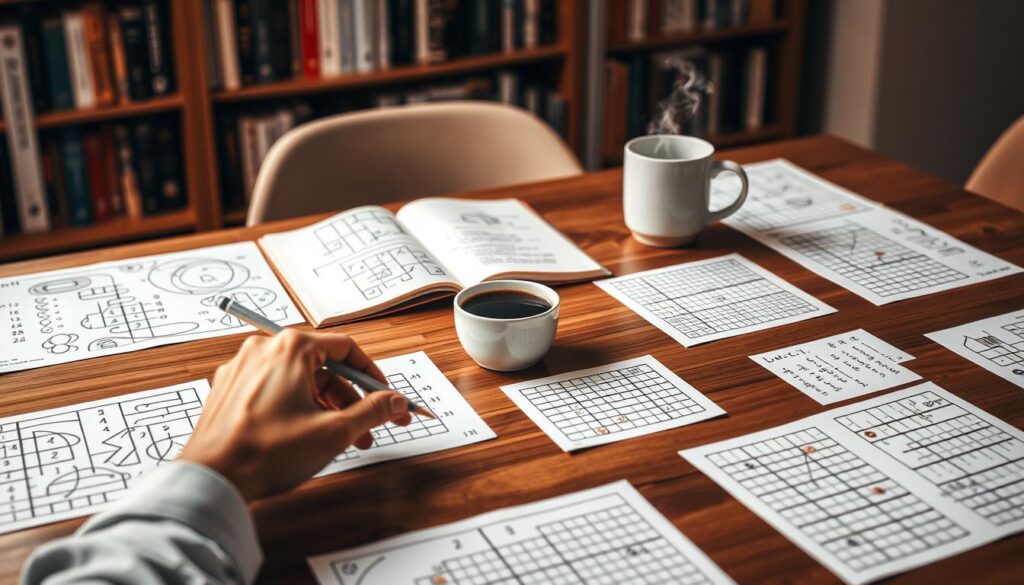
Compact challenges: high cognitive load in short time windows
Grid-based logic puzzles like Sudoku, Nonograms, and Calcudoku require scanning clues, pruning possibilities, then choosing a next move. These steps train the brain to manage multiple tasks under a tight time limit.
From grids to tangrams: puzzle types that train logical reasoning and control
Paper logic grids push accuracy and speed. Tactile tangrams and 3D wooden teasers add fine motor control and spatial rules. Together they build transferable skills for rapid task switching and clearer process thinking.
- What to watch: layout clarity, clue density, and helpful images affect cognitive load.
- Pick the right size and difficulty so training fits short breaks and avoids friction.
- Iterative attempts and brief reflection turn repeated practice into reliable, faster reasoning.
Buyer’s guide: choosing logic puzzles that fit your tasks, time, and settings
Choose sets that fit your daily rhythm so short breaks turn into useful training. Start by matching difficulty and levels to your current tasks and the time you can spare. Reserve higher complexity for low-interruption periods at work.
Difficulty and levels: scaling from quick wins to expert challenges
Look for a clear range of levels so you can progress without losing momentum. Begin with quick wins to build confidence, then add higher difficulty when you have longer stretches of focus.
Tip: choose sets with answer keys or solution booklets to speed learning and reduce frustration.
Design, size, and components: portability, quality materials, and durability
Evaluate size and materials against your usual space. Beech wood labyrinths and timber tangrams last longer than flimsy plastic. Sturdy travel cases keep pieces organized on commutes or in shared offices.
Features that reduce friction at work: spiral binding, large print, and screen-free focus
Paper formats with spiral binding, large print, and simple page layout cut setup time and improve readability. Those small design choices boost daily use and make brief sessions reliable.
“Small design wins—like a spiral spine or clear hints—make practice repeatable in tight schedules.”
- Balance types: grids, search-based, spatial, and tactile sets to avoid plateaus.
- Check component quality and piece tolerances for consistent performance.
- Prefer compact sets that stow easily in limited space and shared settings.
Best paper-and-pencil logic puzzles for on-the-go brain training
Paper puzzles make it easy to squeeze meaningful training into short windows between tasks. These formats need little setup and fit a commute, a coffee break, or a spare five minutes at work.
Tricky Logic Puzzles: 130+ multi-type challenges
Tricky Logic Puzzles packs Sudoku, Nonograms, Calcudoku, logic grids, and cryptic tasks across progressive levels. The variety lets you pick short or deep sessions to match your available time and focus.
Note: occasional solution errors and looser binding mean check answers carefully and keep sessions short when complexity rises.
Brain Games – Large Print Word Searches (Teal)
This spiral-bound title offers 80+ large-print search puzzles with themed secret messages. The clear layout and quality paper reduce eye strain and speed the process of scanning and marking.
Brain Games – Family Feud Word Search
Survey-style questions add layered search difficulty by including unlisted words that boost challenge. Spiral binding and large type make it comfortable for a range of users and shared settings.
- Paper choices excel at portability and quick setup, ideal during micro-breaks.
- Mix number-driven logic and language search to broaden skills and reasoning.
- Break harder puzzles into short segments to protect accuracy and pace.
- Prefer editions with answer keys and clear indexing to check progress fast.
Tip: rotate types weekly and prioritize print quality and layout to keep training efficient and enjoyable.
Tactile wooden brain teasers that require careful, hands-on reasoning
Grip, rotate, and rebuild: wooden sets make abstract planning concrete and repeatable. These tactile puzzles reward hands-on control and slow strategy, so short sessions deliver focused training between tasks.
KINGOU Hexagon Tangram Puzzle: pattern variety and spatial skills
This 11-piece timber set measures about 5.5 x 4.72 inches and uses water-based paint. The compact size supports quick design challenges that train spatial reasoning and creative reconstruction.
KINGOU Wooden Puzzle Magic Ball: ★★★★☆ difficulty for patience and process
The spherical Magic Ball adds layered complexity. It’s challenging to disassemble and reassemble, so it encourages stepwise strategies and patience when tasks demand careful planning.
Included instructions and QR videos speed learning and reduce frustration during repeat attempts.
4 Pack Wooden Puzzle Brain Teasers: mini types for variety and dexterity
This eco-friendly pack includes Snake Cube, Magic Cube, and a small Magic Ball. Each 4.5 cm piece offers a different way to twist, fold, and lock, building fine motor skills and reasoning under mild time pressure.
- Quality wood and smooth finishes make frequent use pleasant and durable.
- Alternate tangram design with interlocking puzzles to broaden training and avoid plateaus.
- Pick clear color contrasts and manageable size to keep shared office use tidy and safe.
Hands-on teasers translate abstract plans into concrete steps, improving control and confidence on higher-friction tasks at work. Use them in rotation to vary difficulty, number of moves, and the type of challenge you face.
Portable handheld maze and ball challenges for micro-breaks
Small labyrinths and memory balls provide a compact way to practice steady control during short breaks. These tactile puzzles fit tight schedules and small space while offering clear, hands-on feedback.
Handheld Wooden Labyrinth Maze
The wooden labyrinth measures 7 x 4.5 x 0.7 inches and uses beech wood with an acrylic cover and a metal marble. Its flip-reset design speeds restarting, so you iterate moves and train pacing without losing time. With 21-hole navigation, the maze builds control, hand-eye coordination, and patience—useful skills for focused work.
YongnKids Amaze 3D Memory Maze Ball
This compact 4-inch sphere holds a tiny BB that travels sequential paths and may require repeated attempts. The ball trains route planning and persistence, though it can frustrate some users and the shell may crack if dropped. Good lighting helps visibility of the small internal piece.
- Fit into desk drawers or commute bags to use between tasks.
- Emphasize tactile feedback and incremental difficulty, not heavy rules.
- Limit tries per session to avoid frustration and spread complexity.
Tabletop STEM and race-to-solve games that boost speed and strategy
Tabletop STEM sets turn short sessions into fast lessons in strategy and timing. These compact titles mix tactile decision-making with a clear win condition, so each round trains pacing and quick planning.
The Genius Square
The Genius Square asks players to roll dice, place blockers, then race to fill a grid. With over 62,000 solution paths, it forces rapid choice-making and hand-eye coordination in brief rounds.
Use solo mode to focus on process and pacing, or play competitively to simulate timed, multi-stakeholder tasks at work.
SmartGames IQ Puzzler Pro
IQ Puzzler Pro offers 120 2D and 3D challenges in a travel case. Levels range from easy to expert, so users can scale difficulty and build spatial skills without long setup.
- Both formats are compact in size and high in component quality.
- They add variety to your training portfolio and strengthen fast pattern recognition.
- Try short, timed sessions for speed, then extend time to deepen problem-solving.
Pocket-size travel logic games for quick sessions anywhere
Carry a compact set of teasers to turn short waits into focused, useful training. A pocket kit lets you do a meaningful mini-session without rearranging your desk or stealing time from key tasks.
30pcs Wooden & Metal Brain Teasers: this unlock/interlock set mixes wooden and metal pieces in a single compact case. The variety of types and components gives a wide range of difficulty and keeps practice fresh.
Why this set works on the go
Mixed-material design increases tactile feedback and trains different problem-solving processes. Interlock and unlock mechanisms train patience and process planning with quick wins to sustain motivation.
- Compact size and durable quality make it easy to carry between work, commute, and meetings.
- Progressive levels let users start simple and move to higher complexity as skills grow.
- Rotate puzzles to spread challenge across number, spatial, and sequence skills.
- Use short micro-sessions to clear mental cache and improve re-entry focus on tasks.
For shared spaces, lay out a small selection to invite colleagues to join. Consider a tiny organizer to keep small components safe during travel and daily use.
Visual-focus and sticker-by-number logic-lite for mindful resets
A brief, image-based activity gives your brain a gentle reset without stealing minutes. Sticker-by-number sets add visual structure and low friction to short breaks. They fit tight schedules and small space while keeping hands and eyes engaged.
Brain Games – Sticker by Number: America’s Top Gun Fighter Planes (28 images)
The kit contains 28 perforated images of fighter planes with numbered sticker spaces. Repositionable stickers and thick paper make the process forgiving. This design reduces mistakes and preserves momentum during quick sessions.
The numbered layout turns assembly into a simple process that eases decision fatigue. It supports fine motor skills, visual scanning, and calm focus. Use one sheet between demanding tasks at work to reset attention without heavy cognitive load.
- Compact size and clean design suit shared desks and short time windows.
- Variety of images keeps the experience fresh and visually engaging.
- Quality paper and repositionable components improve user experience.
Set a short timebox and finish one section per session to reinforce closure and steady progress.
Jigsaw puzzles for deep-focus development and stress relief
Putting together a big jigsaw can turn a single session into a purposeful deep-focus ritual.
Buffalo Games’ 1000-piece “Colorful Country” pairs sturdy interlocking pieces with high-resolution images and a full-color reference poster. The finished size is 26.75 x 19.75, so plan your space before you begin.
The set promotes sustained attention and visual problem-solving. It works well as planned training when you need recovery after high-complexity tasks at work.
Practical tips and setup
- Start with the border and distinct color regions to manage early wins.
- Use a roll-up mat or dedicated table to protect progress and organize pieces.
- Good lighting and ergonomic seating reduce fatigue during longer sessions.
- Integrate jigsaw time into a weekly routine to build focus endurance.
| Feature | Benefit | Recommendation |
|---|---|---|
| Interlocking pieces | Improved flow; fewer separations | Use flat workspace |
| High-res images + poster | Faster color-led process | Sort by color regions |
| 1000-piece size | Higher complexity and time investment | Plan sessions and breaks |
Family-friendly logic games for shared problem-solving and bonding
A quick puzzle round after dinner creates a low-pressure way to sharpen reasoning together. These sets let family members of different ages join short sessions that build skills and connection.
Skrtuan Wooden Hexagon Puzzle uses durable, well-sanded wood and 14 colorful pieces. It supports multiple solutions, so kids and adults can test ideas together. The design promotes fine motor control and critical thinking. Supervise small parts with younger users and store pieces to keep the set complete.
Family Matching Block Game (BBnote)
The matching block set is quick to learn. Flip, spin, and merge colored blocks to match card patterns. Repeated rounds train speed, spatial reasoning, and hand control. Note some users report durability issues; treat components gently to extend life.
- Family sessions compress challenges into short rounds, ideal for busy schedules and after-dinner routines.
- Collaborative play mirrors real coordination tasks and improves communication and planning.
- Rotate types of puzzles to balance number, spatial, and pattern practice across the week.
“Use family play to introduce new types, then adapt solo practice for focused training later.”
| Feature | Skrtuan Hexagon | BBnote Matching Blocks |
|---|---|---|
| Primary benefit | Collaborative spatial puzzles | Fast pattern matching rounds |
| Materials / quality | Well-sanded wood, safe finish | Plastic blocks, some wear concerns |
| Best use | Multi-age bonding and reasoning | Speed, motor skills, quick training |
logic-compression games for adults who multitask excessively
A compact puzzle kit turns waiting time into deliberate, measurable skill work.
This section curates portable, quick-start formats that compress high-value training into minutes. Handheld mazes, mini 3D puzzles, and spiral-bound books start fast and fit fragmented schedules without heavy setup.
Use short timeboxes, checkpoint partial completions, and rotate paper with tactile pieces to avoid overload. Pick difficulty to match current tasks and settings so each brief session feels doable yet meaningful.
| Format | Quick-start features | Best use |
|---|---|---|
| Spiral-bound paper | Large print, answer keys | Desk breaks, low-friction training |
| Handheld mazes | Flip-reset, tactile feedback | Commute pockets, short focus bursts |
| Mini 3D puzzles | Durable pieces, compact case | Hands-on control, spatial practice |
The emphasis is on reasoning and pattern recognition to regain control amid frequent context switches. Build a lightweight kit to carry daily and mix image-driven activities with rule-based puzzles to tune mental intensity and sustain progress.
Difficulty, levels, and settings: match the challenge to your current cognitive load
Match the puzzle’s challenge to your mental load to get useful practice without burning out. Calibrate difficulty so training supports work instead of adding stress.
Start easy when your day is dense and step up as focus and time allow. Use puzzles with clear levels and answer keys to move forward without stalling.
- Timebox sessions and pick settings—quiet or noisy—that suit the chosen difficulty.
- Track moves, mistakes, or completion time to measure progress and adjust complexity.
- Rotate puzzle types to spread load across number, spatial, and pattern reasoning.
- Favor compact formats with fast resets for short windows; save multi-layered puzzles for longer blocks.
| Setting | Best level | Recommended features |
|---|---|---|
| Busy desk / meeting gaps | Beginner–intermediate | Large print, quick resets, answer keys |
| Quiet focus block | Intermediate–advanced | Multi-step puzzles, higher complexity, timing |
| Commute / short waits | Quick-win levels | Compact size, tactile pieces, simple rules |
Adopt a process that starts with quick wins to build momentum. Reassess weekly so your range of levels matches current goals and the demands of your tasks.
Design, size, and components: choosing materials and features that improve use
When your desk is tight, the right size and finish decide whether you’ll actually use a set. Good design reduces friction and makes short training sessions feel easy to start.
Prioritize ergonomic choices: spiral-bound paper with large print lays flat and speeds reading. Beech wood labyrinths and quality timber tangrams hold up to daily use and feel satisfying in hand.
Size and component tolerances matter in small space. Compact cases with tight-fitting pieces prevent loss, support clean resets, and keep complexity manageable during quick tasks.
Look for practical features that streamline the process: answer keys, quick-reference posters, or an app that logs progress. Quiet components and stable bases keep noise low at work.
| Design element | Benefit | Recommendation |
|---|---|---|
| Spiral-bound paper | Flat lay, fast scanning | Large print, thick paper |
| High-quality timber | Durable feel, longevity | Beech or hardwood pieces |
| Travel case | Protects components | Compact, modular inserts |
Test sets on your desk or tray table before you buy. Track wear and the user experience over time to refine future choice and maintain quality training routines.
Training your brain like code: processes, patterns, and no-code development
Turn puzzle habits into repeatable processes that map directly to app development workflows.
Break tasks into small, testable steps the way you would write a function. That approach makes complex work manageable and lets your brain reuse patterns across many problems. Treat each short puzzle session as a micro-prototype of a development sprint: define the goal, test one idea, record the result, then iterate.
From puzzle logic to app logic: explore hyperPad to build behaviors without code
hyperPad is an iPad no-code engine that uses drag-and-drop objects and visual logic behaviors. Users can build platformers, RPGs, and puzzle-style interactions without writing code. That makes it a practical bridge from pattern practice into lightweight development.
“Modular prefabs and templates let you scale complexity by reusing tested behaviors across scenes.”
Key features mirror puzzle strategies: Prefabs/Templates share logic across scenes. Debounce and Hover control input timing, much like pacing decision steps in a short, high-density task. Revamped joystick and tilt controls teach control mapping and feedback loops that resemble real-world constraints.
| Feature | How it maps to puzzle practice | Best use |
|---|---|---|
| Prefabs / Templates | Reuse patterns across levels | Scale complexity efficiently |
| Debounce & Hover events | Control input timing and state | Simulate paced decision steps |
| Joystick / Tilt controls | Teach control mapping and feedback | Model physical constraints in prototypes |
Export to the App Store via Xcode shows how small, iterative builds can become production outputs. Use timed prototypes to simulate short challenge windows and balance difficulty and scope, just like you would with tactile or paper puzzles. Tap the Hub and forums for feedback and a variety of examples to speed skill development and improve the quality of your work.
Fitting challenges into limited time and space: timeboxing, rotation, and variety
Turn spare minutes into reliable practice by scheduling tiny, repeatable puzzle sessions.
Timebox each session—set 5–10 minutes and stop when the alarm rings. Short limits protect energy for primary tasks while keeping training consistent.
Rotate types across sessions: use paper sheets, a travel case, an image-based activity, then a tactile set. This spreads cognitive load and keeps the brain engaged without overloading one type of challenge.
Map complexity to the space and interruptions at hand. Keep small, high-yield puzzles ready when desk space is tight or noise is high. Step up difficulty during quiet blocks.
Standardize a simple process: pick, play, record a number or time, then reset. That little routine makes progress measurable and removes setup friction.
Prioritize features that speed use—spiral binding, compact cases, clear design, and quick-reset pieces. Maintain a compact kit you like at your desk, in your bag, or on the couch to reduce barriers.
“Short, consistent practice beats long sessions that are hard to schedule.”
| Setting | Best mini-session | Key feature |
|---|---|---|
| Busy desk | 5–7 minute paper puzzles | Spiral binding, large print |
| Commute or pocket | Handheld maze or mini set | Travel case, flip-reset |
| Quiet block | Longer, higher-complexity puzzles | 2D/3D challenges, solution keys |
| Weekly review | Adjust range and levels | Record times, note fatigue |
Conclusion
A steady habit of mini sessions turns scattered minutes into measurable gains in speed and accuracy at work.
Use a balanced kit of paper puzzles, tactile sets, handheld mazes, tabletop races, and image-based activities to cover multiple skills and challenges. Focus on quality components and low-friction features so training fits existing tasks and space without extra setup.
Timebox practice, rotate types to avoid plateaus, and track simple metrics — time to solve, mistakes, or steps — to visualize progress. When ready, map puzzle process to no-code development in hyperPad to turn pattern thinking into interactive projects.
Start small, build momentum, and refine your choice by experience. Regular, deliberate practice will sharpen reasoning and make complex work more manageable.